
01 · Foam formation
Creation of gas-liquid interfacial area
Foam generation requires creation of a large gas-liquid interfacial area. Mechanical agitation, sparging, shaking, whipping, turbulent mixing and gas injection are common routes. The energetic cost of area creation is governed initially by the surface tension of the interface at the relevant age. During rapid generation, dynamic rather than equilibrium surface tension is therefore the appropriate quantity. [P1, P2, 1, 2, 7]
Interfacial work
02 · Dynamic adsorption
Adsorption during rapid surface creation
If adsorption is slower than interface creation, the new bubble surface can retain a tension close to that of the pure solvent during the earliest stages. Rapidly adsorbing surfactants reduce this cost more effectively on process timescales. Foam formation is thus connected directly to adsorption kinetics. [P1, P2, 1, 2, 7]
03 · Bubble stabilization
Generating bubbles is only the first step
Generating bubbles is only the first step. Newly formed bubbles collide and may coalesce before they enter a stable foam network. Stabilization therefore requires sufficiently rapid formation of adsorption layers and sufficiently persistent liquid films between approaching bubbles. [P2, P4, 8, 1, 2]
The role of surfactants is not simply to lower surface tension. Surface concentration gradients created during rapid deformation produce Marangoni stresses, and the adsorption layer can possess dilational and shear viscoelasticity. These properties oppose local expansion and can slow film thinning or redistribute liquid toward disturbed regions. [P2, P4, 8, 1, 2]
04 · Fundamental distinction
Foamability is not foam stability
Foamability is the ability of a liquid to generate a foam under a defined gas input or mechanical protocol. Stability is the resistance of that foam to decay after its generation. A system can be highly foamable but unstable if films rupture rapidly, or weakly foamable but long-lived once a foam has formed. Any analytical method should state which property is being measured. [P1, P2, 1, 2, 7]
05 · Multiscale interpretation
From foam generation to molecular adsorption layers
A foam consists of gas bubbles separated by liquid structures. At high liquid fraction, bubbles are nearly spherical and separated by relatively thick liquid layers. As liquid drains, bubbles deform into polyhedral shapes and the liquid becomes concentrated in Plateau borders and nodes. The faces between neighboring bubbles are thin liquid films bounded by two adsorption layers. [P2, P4, 8, 1, 2]
The Miller’s lecture introduces a top-down view of foam precisely because no single structural level explains the whole system. A macroscopic foam column can be analyzed through its height, liquid content and lifetime. At the next scale, individual bubbles and Plateau borders determine capillary pressure and drainage. At still smaller scales, thin films control whether neighboring bubbles remain separated or coalesce. Finally, the properties of those films depend on the molecular adsorption layers at their two surfaces. [P1, P2, 3, 6, 8]
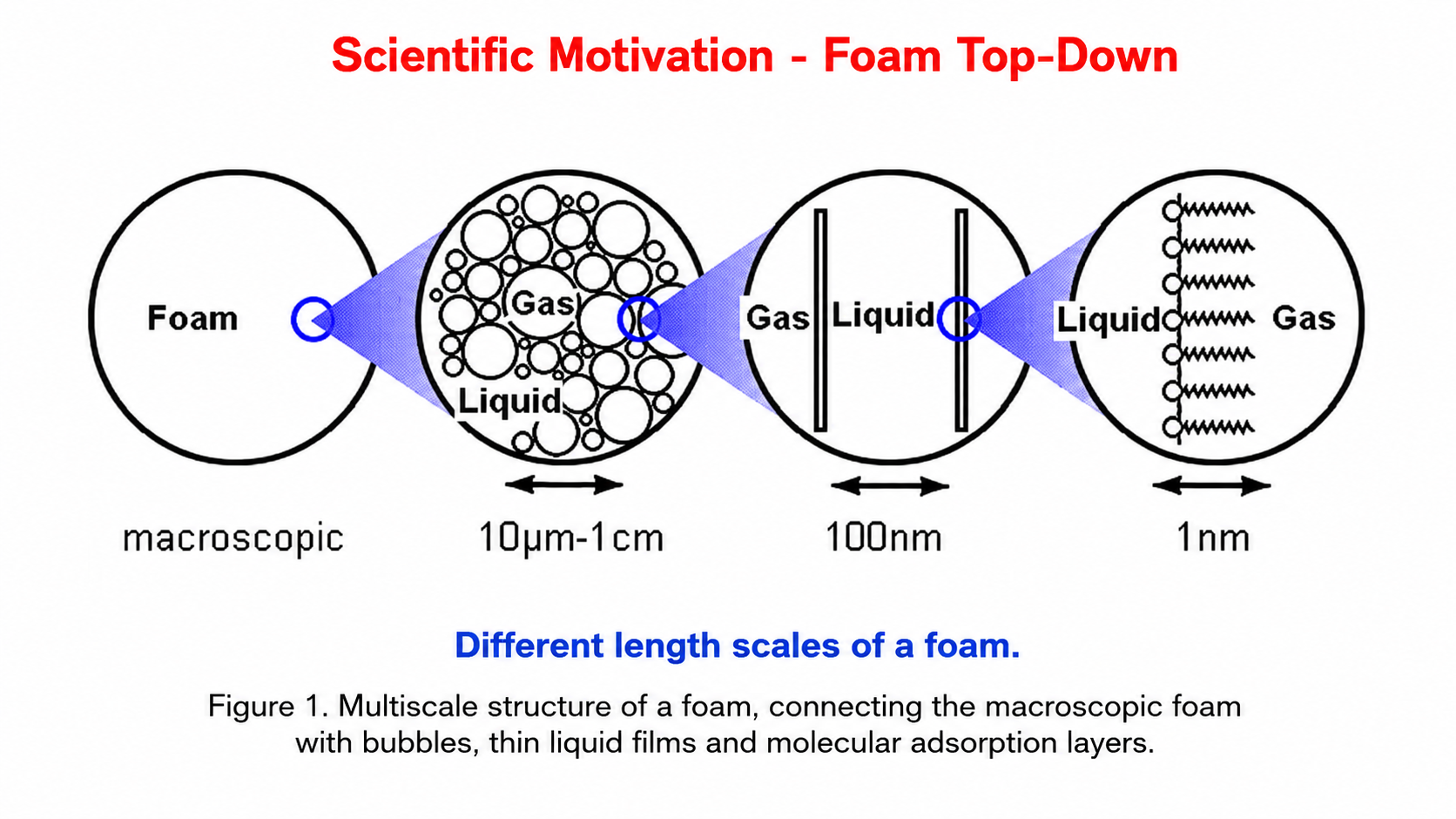
This hierarchy is central to the 2018 monograph edited by Exerowa, Gochev, Platikanov, Liggieri and Miller. The scientific logic runs from adsorption layers through liquid films to real foams rather than treating foam volume as an isolated empirical property. [P2, P4, 8, 1, 2]
References
Scientific literature
- 1.D. Exerowa and P. M. Kruglyakov, Foam and Foam Films: Theory, Experiment, Application, Elsevier, Amsterdam, 1998.
- 2.D. Exerowa, G. Gochev, D. Platikanov, L. Liggieri and R. Miller (Eds.), Foam Films and Foams: Fundamentals and Applications, CRC Press, 2018.
- 3.Khr. Khristov, D. Exerowa, L. Christov, A. V. Makievski and R. Miller, Foam analyzer: An instrument based on the foam pressure drop technique, Review of Scientific Instruments 75 (2004).