
00 · Abstract
Abstract
Foams are gas-in-liquid dispersions whose macroscopic properties emerge from a hierarchy of structures extending from molecular adsorption layers to thin liquid films, Plateau borders, bubbles and finally the complete foam column. This hierarchy makes foam analysis intrinsically multiscale. A formulation that produces large foam volume is not necessarily stable, and a surfactant that strongly lowers equilibrium surface tension is not automatically an effective foam stabilizer. Formation, drainage, coarsening, film thinning and rupture involve different physical mechanisms and occur over different time and length scales. [P2, P4, 8, 1, 2]
The primary scientific framework of this review follows Miller's lectures on foam films and foams. These lectures explicitly organize the subject through a top-down analysis of the foam, the DLVO description of thin-film interactions, methods of foam formation and characterization, single-bubble experiments and foam-film studies. This structure is complemented by the monographs Foam and Foam Films by Exerowa and Kruglyakov and Foam Films and Foams: Fundamentals and Applications edited by Exerowa, Gochev, Platikanov, Liggieri and Miller. The latter work emphasizes the same hierarchical philosophy: adsorption layers determine properties of foam films, foam films are the building blocks of real foams, and macroscopic foam behavior cannot be interpreted rigorously without connecting all three levels. [P1, P3, 1, 2, 8]
A major experimental challenge is to distinguish foamability from foam stability. Foamability describes the ability of a liquid to generate and retain gas during a defined formation protocol. Stability describes the persistence of the generated foam under drainage, capillary pressure, coarsening and film-rupture stresses. Classical methods such as the Ross-Miles test quantify foam height after standardized pouring, while automated foam columns follow foam volume and liquid volume as functions of time. More advanced approaches analyze drainage, water content and lifetime under an imposed pressure difference. [P1, P2, 3, 6, 1]
Particular emphasis is placed on the foam pressure-drop technique developed by Khristov, Exerowa, Christov, Makievski and Miller. Their Foam Analyzer applies a controlled reduced pressure to accelerate otherwise long stability experiments and permits the measurement of foam water content, drainage rate and lifetime as functions of pressure. The method connects macroscopic drainage behavior with the types of liquid films existing inside the foam, including common thin films, common black films and Newton black films. [P1, P3, 3, 6, 1]
Single-bubble and pair-interaction methods provide the complementary bottom-up view. The Drop-Bubble Micro Manipulator developed by Won, Krägel, Makievski, Javadi, Gochev, Loglio and collaborators allows controlled interaction of two bubbles, two drops or a drop and a bubble, while pressure, geometry and coalescence can be monitored. These model experiments film formation, dimple development, critical thinning and rupture processes that are difficult to identify inside an opaque macroscopic foam. [P1, P2, 4, 1, 2]
The principal conclusion is that foam analysis should not search for one universal stability parameter. Surface tension, dynamic adsorption, interfacial rheology, film disjoining pressure, drainage, bubble-size distribution and capillary pressure all contribute, but their influence depends on formulation and experimental conditions. Rigorous characterization therefore requires a defined foam-generation protocol and multiple complementary observables across molecular, film and foam scales. [P1, P3, 1, 2, 8]
Keywords
Keywords
foam analysis; foamability; foam stability; foam drainage; foam lifetime; foam pressure drop; Ross-Miles test; foam column; thin liquid films; common thin film; common black film; Newton black film; disjoining pressure; DLVO theory; single bubble; Drop-Bubble Micro Manipulator; surfactants [P1, P3, 3, 6, 4]
01 · Scientific Review
Foams as hierarchical interfacial systems
A foam consists of gas bubbles separated by liquid structures. At high liquid fraction, bubbles are nearly spherical and separated by relatively thick liquid layers. As liquid drains, bubbles deform into polyhedral shapes and the liquid becomes concentrated in Plateau borders and nodes. The faces between neighboring bubbles are thin liquid films bounded by two adsorption layers. [P2, P4, 8, 1, 2]
Miller lecture introduces a top-down view of foam precisely because no single structural level explains the whole system. A macroscopic foam column can be analyzed through its height, liquid content and lifetime. At the next scale, individual bubbles and Plateau borders determine capillary pressure and drainage. At still smaller scales, thin films control whether neighboring bubbles remain separated or coalesce. Finally, the properties of those films depend on the molecular adsorption layers at their two surfaces. [P1, P2, 3, 6, 8]
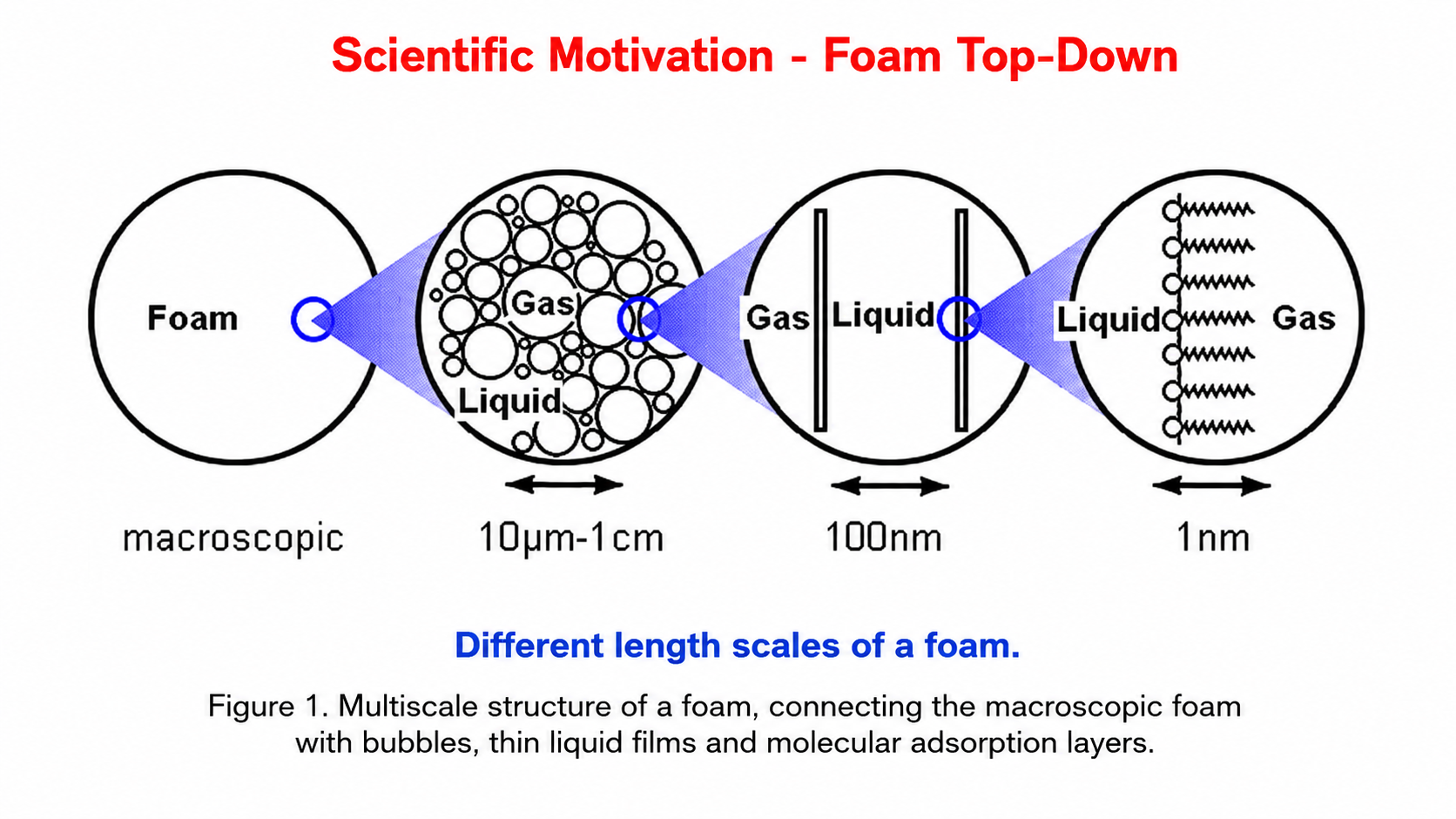
This hierarchy is central to the 2018 monograph edited by Exerowa, Gochev, Platikanov, Liggieri and Miller. The scientific logic runs from adsorption layers through liquid films to real foams rather than treating foam volume as an isolated empirical property. [P2, P4, 8, 1, 2]
Central principle. Foam stability is an emergent multiscale property. A molecular measurement can be necessary for understanding stability without being sufficient to predict it quantitatively. [P1, P2, 1, 2, 7]
02 · Scientific Review
Foam formation
2.1 Creation of gas-liquid area
Foam generation requires creation of a large gas-liquid interfacial area. Mechanical agitation, sparging, shaking, whipping, turbulent mixing and gas injection are common routes. The energetic cost of area creation is governed initially by the surface tension of the interface at the relevant age. During rapid generation, dynamic rather than equilibrium surface tension is therefore the appropriate quantity. [P1, P2, 1, 2, 7]
Interfacial work
If adsorption is slower than interface creation, the new bubble surface can retain a tension close to that of the pure solvent during the earliest stages. Rapidly adsorbing surfactants reduce this cost more effectively on process timescales. Foam formation is thus connected directly to adsorption kinetics. [P1, P2, 1, 2, 7]
2.2 Bubble breakup and stabilization
Generating bubbles is only the first step. Newly formed bubbles collide and may coalesce before they enter a stable foam network. Stabilization therefore requires sufficiently rapid formation of adsorption layers and sufficiently persistent liquid films between approaching bubbles. [P2, P4, 8, 1, 2]
The role of surfactants is not simply to lower surface tension. Surface concentration gradients created during rapid deformation produce Marangoni stresses, and the adsorption layer can possess dilational and shear viscoelasticity. These properties oppose local expansion and can slow film thinning or redistribute liquid toward disturbed regions. [P2, P4, 8, 1, 2]
2.3 Foamability versus stability
Foamability is the ability of a liquid to generate a foam under a defined gas input or mechanical protocol. Stability is the resistance of that foam to decay after generation. A system can be highly foamable but unstable if films rupture rapidly, or weakly foamable but long-lived once a foam has formed. Any analytical method should state which property is being measured. [P1, P2, 1, 2, 7]
03 · Scientific Review
Foam geometry and capillary pressure
The pressure inside a curved bubble exceeds the pressure in the surrounding liquid by the Laplace pressure. For a spherical bubble with radius R and one gas-liquid interface, the idealized relation is Δp=2γ/R. In a polyhedral foam, local curvature varies between films, Plateau borders and nodes, making capillary pressure spatially heterogeneous. [P1, P2, 1, 2, 7]
Young-Laplace pressure
The Miller lecture emphasizes that in a gravitational field the capillary pressure of a foam depends on height within a foam column. Consequently, film thickness, Plateau-border radius, local liquid fraction and stability can vary along the column. A foam column is therefore not automatically a spatially uniform sample. [P1, P2, 1, 2, 7]
This has an important experimental consequence: foam volume and collapse time measured at one macroscopic location can integrate a vertical distribution of liquid content and capillary stress. Techniques that quantify drainage or impose a controlled pressure can reduce this ambiguity. [P1, P2, 1, 2, 7]
04 · Scientific Review
Drainage
4.1 Gravity-driven liquid redistribution
Immediately after foam generation, much of the continuous liquid phase resides in Plateau borders and relatively thick films. Gravity drives liquid downward, while capillary pressure gradients pull liquid through the Plateau-border network. The foam becomes progressively drier. [P1, P2, 1, 2, 7]
Drainage changes the geometry and therefore the mechanical state of the foam. As the liquid fraction decreases, films thin and the capillary pressure increases. The probability that a local film reaches a critical rupture state therefore grows even when the molecular composition of the adsorption layer remains unchanged. [P2, P4, 8, 1, 2]
4.2 Drainage rate as a foam descriptor
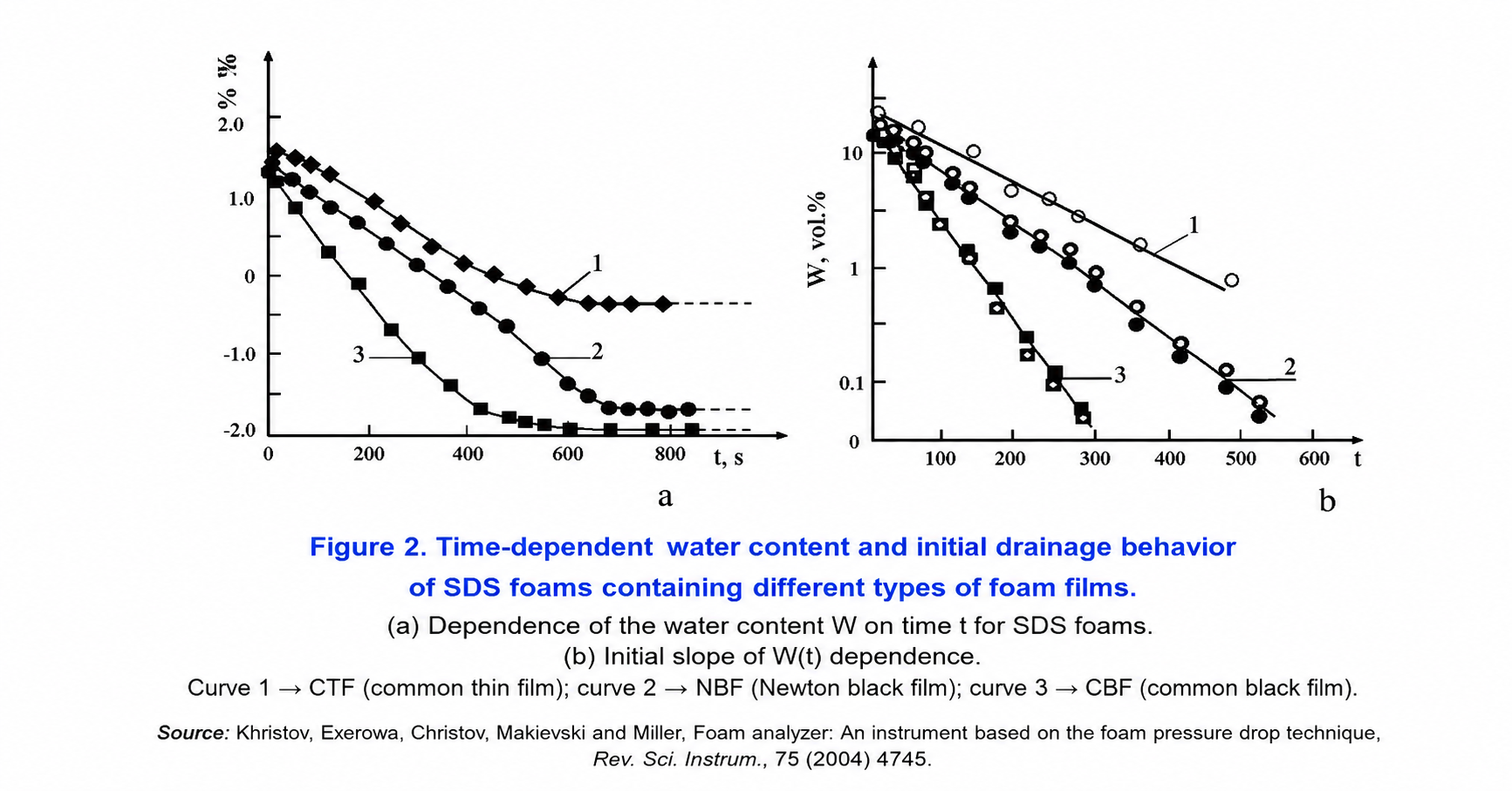
The time-dependent liquid or water content W(t) is a direct experimental measure of drainage. The initial slope of W(t) provides a convenient comparative drainage rate. The FA1 work of Khristov, Exerowa, Christov, Makievski and Miller uses precisely this quantity to compare foams formed from different surfactant systems. [P1, P2, 3, 6, 1]
Initial drainage descriptor
The sign convention is chosen so that a larger positive D0 corresponds to faster liquid loss. It is not a universal material constant because the result depends on foam geometry, bubble size, applied pressure and the foam-generation protocol. [P1, P2, 1, 2, 7]
4.3 Relation to film type
The lecture material compares water-content curves for SDS foams associated with common thin films, common black films and Newton black films. The observation is important because macroscopic drainage is not independent of film structure. Changes in disjoining pressure and equilibrium thickness alter how liquid is distributed between films and Plateau borders. [P1, P3, 1, 2, 6]
05 · Scientific Review
Thin films as the structural elements of foam
Two neighboring bubbles are separated by a thin liquid film containing a liquid core and two adsorption layers. The stability of this film determines whether the bubbles remain or coalesce. The Miller lecture therefore identifies foam films as the main elements of a foam. [P2, P4, 8, 1, 2]
Three classical film states are distinguished: common thin film (CTF), common black film (CBF) and Newton black film (NBF). Their thickness and stability reflect a balance between capillary pressure and surface forces acting across the film. [P1, P3, 1, 2, 6]
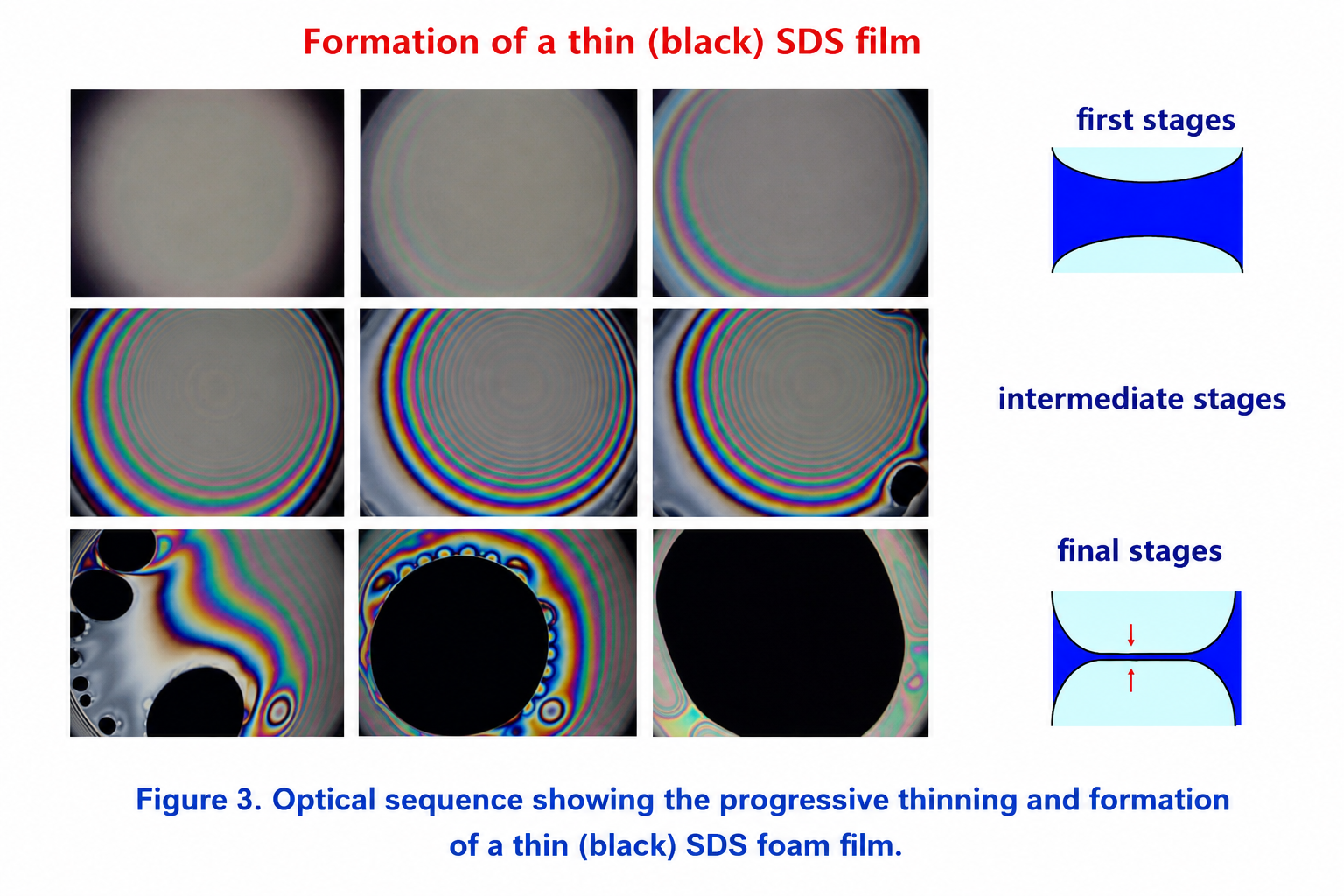
The transition from a thick film to a black film is an optical manifestation of thinning. Interference colors disappear as thickness falls below the range producing visible reflected-light interference, giving rise to the historical term black film. [P1, P2, 1, 2]
06 · Scientific Review
Disjoining pressure and DLVO framework
6.1 Pressure balance
When a liquid film becomes sufficiently thin, the two interfaces interact. The resulting interaction is expressed through the disjoining pressure Π(h), defined as the excess normal pressure associated with the film at thickness h relative to a bulk liquid layer. At equilibrium, this interaction pressure balances the externally imposed capillary pressure. [P1, P3, 1, 2, 7]
Film pressure balance
A stable film thickness corresponds to an intersection of the disjoining-pressure isotherm with the imposed pressure that is mechanically stable against small thickness perturbations. [P1, P3, 1, 2]
6.2 DLVO contributions
The classical DLVO description combines van der Waals attraction and electrostatic double-layer repulsion. The Miller lecture explicitly introduces the contributions of Derjaguin, Landau, Verwey and Overbeek and uses primary and secondary minima to connect interaction potentials with stable and metastable film states. [P1, P3, 1, 2, 6]
Conceptual DLVO decomposition
For a simple symmetric geometry, the attractive van der Waals contribution scales approximately as -A_H/(6πh³), where A_H is the Hamaker constant. Electrostatic repulsion depends on surface potential or charge, electrolyte concentration and the Debye screening length. [P1, P3, 1, 2]
6.3 Beyond DLVO
At nanometer thicknesses, hydration, steric, structural and specific-ion forces can become important. Newton black films in particular can enter a regime where short-range interactions are comparable to or larger than the classical diffuse-double-layer contribution. DLVO therefore provides a foundational framework rather than a complete universal description. [P1, P3, 1, 2, 6]
07 · Scientific Review
Macroscopic foam characterization
7.1 Foam column methods
A foam column provides a straightforward macroscopic geometry. A defined amount of solution is foamed by a defined amount or flow of gas, and the foam and liquid volumes are recorded as functions of time. The resulting curves separate formation, drainage and collapse only imperfectly but provide a reproducible engineering description when the protocol is standardized. [P1, P2, 1, 2, 7]
The lecture material notes that similar column principles have been used for beer-foam testing. This illustrates an important point: standardized macroscopic foam tests are often application-specific. They are useful precisely because they reproduce a practical process, even when they do not isolate a single fundamental mechanism. [P1, P2, 1, 2]
7.2 Ross-Miles test
The Ross-Miles test is a classical standardized foamability method. A surfactant solution falls from a defined height into a receiving solution, generating foam by impact and entrainment. Foam height is measured immediately and after a defined aging period. [P1, P2, 1, 2, 7]
The result combines foam generation and early decay. It is excellent for comparative quality control but cannot independently identify whether differences arise from adsorption rate, drainage, bubble size, film stability or coarsening. [P1, P2, 1, 2, 7]
7.3 Automated optical foam scanning
Automated foam scanners improve temporal resolution by recording foam and liquid heights continuously. They can provide foam-volume decay, drainage kinetics and sometimes bubble-size or structure information. The lecture material presents FoamScan-type instrumentation as an evolution from simple endpoint tests toward time-resolved foam characterization. [P1, P2, 1, 2, 7]
08 · Scientific Review
Foam pressure-drop analysis
8.1 Scientific rationale
Very stable foams can require impractically long experiments under gravity. Khristov, Exerowa, Christov, Makievski and Miller developed a foam pressure-drop technique in which a controlled reduced pressure is applied to the foam. Increasing the pressure difference increases the capillary stress on the films and accelerates drainage and rupture. [P1, P2, 3, 6, 1]
The method transforms foam lifetime from a single passive observation into a response function of applied pressure. This provides more information than measuring collapse time at atmospheric conditions alone. [P1, P2, 3, 6, 1]
8.2 FA1 Foam Analyzer
The FA1 described in Miller lecture and the 2004 Review of Scientific Instruments is a fully automated implementation of the pressure-drop concept. It contains dedicated foam generation, drainage and lifetime measurement sections together with valves, pumps and pressure control. [P1, P2, 3, 6, 1]
The instrument determines water content W(t), drainage behavior and foam lifetime under a defined reduced pressure. Because the pressure can be varied systematically, one can compare foams at equivalent capillary stress rather than relying solely on gravity-driven aging. [P1, P2, 3, 6, 1]
8.3 Lifetime versus pressure
A pressure-lifetime curve reveals how close a foam is to film instability. Stable films can survive modest pressure while rupture accelerates above a characteristic stress range. Different surfactants and different film states can therefore generate distinct pressure dependences. [P1, P3, 3, 6, 1]
8.4 Why reduced pressure is informative
Reduced pressure acts as a controlled acceleration of the natural capillary stresses present in a draining foam. It shortens experiments while retaining a physical connection to film stability. The lecture summary explicitly notes that partial vacuum is useful for foam characterization because it reduces lifetime significantly. [P1, P2, 3, 6, 1]
09 · Scientific Review
Single-bubble and pair-interaction studies
9.1 Why isolate bubbles?
A macroscopic foam contains thousands or millions of interacting bubbles. Isolating one or two interfaces eliminates the structural complexity of the foam network and allows direct observation of the event that ultimately destroys the foam: formation, thinning and rupture of a liquid film between neighboring bubbles. [P1, P2, 1, 2]
9.2 Drop-Bubble Micro Manipulator
The Drop-Bubble Micro Manipulator described by Won, Krägel, Makievski, Javadi, Gochev, Loglio and co-workers uses controlled dosing systems, piezo drives and pressure sensors to position and deform two drops, two bubbles or a drop and a bubble. The two interfaces can be brought together according to a defined approach protocol while geometry, capillary pressure and coalescence are observed. [P1, P2, 4, 1, 2]
The method can mimic the interaction of neighboring bubbles in a foam, neighboring drops in an emulsion or more complex arrangements relevant to multiple emulsions. Fast video can be added for rapid coalescence events. [P1, P2, 1, 2]
9.3 Film formation between approaching bubbles
As two bubbles approach, the liquid trapped between them is squeezed outward. A dimple forms because drainage from the center is slower than drainage near the film rim. The film subsequently thins. At a critical condition, black spots may nucleate and grow, producing a common or Newton black film, or the film may rupture directly. [P1, P3, 4, 1, 2]
This sequence - approach, dimple, thinning, black-spot formation, black-film growth and eventual rupture or stabilization - is explicitly highlighted in the Miller foam lecture and provides the microscopic basis of coalescence. [P1, P2, 4, 1, 2]
10 · Scientific Review
Foam-film measurements
10.1 Film thickness
Film thickness is one of the most informative microscopic observables. Optical interference permits time-resolved thickness measurements from hundreds of nanometers down toward black-film regimes. The film color sequence reflects the optical path difference between light reflected from the two interfaces. [P1, P2, 1, 2]
10.2 Film tension versus surface tension
A foam film contains two interacting interfaces. Its mechanical free energy per area cannot always be represented simply as twice the surface tension of a single isolated adsorption layer. Film tension and surface tension are therefore distinct concepts, a point emphasized directly in Miller's thin-film lecture. [P2, P4, 8, 5, 1]
10.3 Film lifetime
Film lifetime is the interval from formation to rupture under a defined pressure, geometry and drainage protocol. It depends on film radius, capillary pressure, bulk viscosity, interfacial mobility, disjoining pressure and the statistical nucleation of rupture. It should not be interpreted as an intrinsic molecular constant. [P1, P3, 3, 6, 1]
11 · Scientific Review
Role of interfacial adsorption layers
The adsorption layers bounding a foam film control surface tension, dynamic adsorption, Marangoni restoring stresses and interfacial rheology. Rapid local expansion can lower surface concentration and raise tension, generating flow toward the depleted region. This mechanism can oppose film thinning and stabilize local disturbances. [P2, P4, 8, 1, 2]
However, Miller's take-home message is deliberately cautious: adsorption-layer properties are essential for film and foam stability, but no direct general correlation between one adsorption-layer parameter and macroscopic foam stability is known. This prevents the common oversimplification that a high dilational modulus or a low equilibrium tension automatically predicts a stable foam. [P1, P2, 1, 2, 7]
The reason is multivariate. A film can be stabilized by disjoining pressure while draining rapidly, or possess strong interfacial elasticity but rupture through a local defect. Bubble-size distribution and gas diffusion can change the foam structure independently of interfacial rheology. [P1, P3, 1, 2, 8]
12 · Scientific Review
Foam destabilization mechanisms
12.1 Drainage
Liquid drainage reduces film and Plateau-border dimensions and raises local capillary stress. It is often the earliest macroscopic aging mechanism. [P1, P2, 1, 2, 7]
12.2 Coalescence
Coalescence occurs when the film separating two bubbles ruptures and the gas volumes merge. Film rupture can follow progressive thinning or be triggered by defects, particles or local mechanical disturbances. [P1, P2, 4, 1, 2]
12.3 Coarsening
Gas diffusion from smaller, higher-pressure bubbles toward larger, lower-pressure bubbles increases the mean bubble size with time. Coarsening changes Plateau-border geometry and can accelerate drainage and coalescence even if no film has ruptured initially. [P1, P2, 1, 2, 7]
12.4 Disproportionation and Ostwald-type gas transfer
The Laplace-pressure difference between bubbles provides the thermodynamic driving force for gas redistribution. Gas solubility and permeability of the continuous phase determine the rate. Formulations designed for long-term stability must therefore consider gas transport as well as liquid-film mechanics. [P1, P2, 1, 2]
13 · Scientific Review
Interfacial rheology and foam response
Dilational viscoelasticity describes the tension response to area changes, while shear rheology probes lateral network strength. Both can influence foam stability, but their importance depends on the deformation mode experienced by the film. [P2, P4, 8, 1, 2]
Low-molecular-weight surfactants often exchange rapidly between interface and bulk, producing frequency-dependent dilational response. Proteins, polymers and particles can form more persistent two-dimensional structures with substantial shear elasticity. These differences help explain why chemically different foaming agents can produce similar foam volume but very different drainage and rupture behavior. [P2, P4, 8, 1, 2]
14 · Scientific Review
Surfactant concentration and foam behavior
Increasing surfactant concentration generally accelerates adsorption and can improve foam generation at low concentration. Once the interface is sufficiently populated, further increases do not necessarily increase stability proportionally. Micellization, changes in surface mobility and film interaction forces can alter the response. [P1, P2, 1, 2, 7]
Electrolyte can modify ionic surfactant films by screening electrostatic repulsion. This may reduce disjoining pressure while simultaneously accelerating adsorption and changing surface rheology. The resulting foam stability can therefore increase or decrease depending on which mechanism dominates. [P1, P3, 1, 2, 8]
15 · Scientific Review
Proteins and mixed foaming systems
Proteins adsorb more slowly than many low-molecular-weight surfactants but can form mechanically strong interfacial networks after adsorption and unfolding. Protein foams therefore display pronounced dependence on interfacial age. The beta-lactoglobulin examples in Miller's film lectures illustrate the formation of protein-stabilized thin films. [P1, P2, 1, 2]
Mixed protein-surfactant systems are particularly complex because surfactants can compete with, penetrate or displace protein layers. Macroscopic foam tests alone cannot distinguish these mechanisms; dynamic tensiometry, interfacial rheology and model film experiments are needed for mechanistic interpretation. [P2, P4, 8, 1, 2]
16 · Scientific Review
Experimental design
16.1 Standardize foam generation
Gas type, flow rate, sparger geometry, solution volume, agitation energy and formation time determine the initial bubble population. These quantities must be controlled before stability data can be compared. [P1, P2, 1, 2]
16.2 Measure liquid fraction
Foam height alone can be misleading because two foams of the same height may contain different amounts of liquid. Water content or liquid volume should therefore be followed whenever drainage is central to the question. [P1, P2, 3, 6, 1]
16.3 Control temperature
Temperature changes viscosity, surface tension, adsorption, gas solubility and drainage. It also affects protein conformation and nonionic surfactant phase behavior. [P2, P4, 8, 1, 2]
16.4 Define pressure conditions
For pressure-drop measurements, the applied reduced pressure and pressure history must be reported. For gravity-only experiments, foam-column height matters because capillary pressure varies along the column. [P1, P2, 3, 6, 1]
16.5 Use complementary scales
A strong foam analysis workflow combines macroscopic foam decay with at least one microscopic or interfacial measurement. This can be thin-film thickness, pair-coalescence time, dynamic surface tension or interfacial rheology depending on the hypothesis. [P2, P4, 8, 1, 2]
17 · Scientific Review
Applications
17.1 Food and beverages
Beer foam, whipped products, ice cream and aerated foods require controlled foamability and stability. In beer, long-lived fine foam is desirable, while excessive foam during processing or filling is not. Standardized foam-column methods are therefore directly relevant. [P1, P2, 1, 2, 7]
17.2 Detergency
Foam can be desirable as a sensory indicator in consumer cleaning but undesirable in industrial washing equipment. Surfactant formulations must therefore balance detergency with controlled foam formation and collapse. [P1, P2, 1, 2, 7]
17.3 Pharmaceuticals and biotechnology
Foam generated during mixing or pumping can expose proteins to repeated air-water interfaces. Analysis of foamability and film stability can therefore help identify formulations susceptible to interfacial stress. [P1, P2, 1, 2, 7]
17.4 Mineral processing
Flotation relies on controlled attachment of particles to bubbles and on sufficiently persistent froth to transport particles. Foam drainage, bubble coalescence and particle-laden film stability are central process variables. [P1, P2, 1, 2, 7]
17.5 Anti-foam development
In fermentation, coatings and process equipment, foam can be . Anti-foam agents operate by disrupting adsorption layers or films and promoting rupture. Model-film and single-bubble experiments are particularly useful for distinguishing these mechanisms. [P2, P4, 8, 1, 2]
18 · Scientific Review
Recommended reporting standard
A foam experiment should report complete liquid composition, surfactant concentration, electrolyte, pH, temperature and preparation history. Foam generation must be specified by gas, gas-flow rate or mechanical energy, formation duration, liquid volume and vessel geometry. [P1, P2, 1, 2, 7]
Macroscopic outputs should distinguish initial foamability, foam volume decay, liquid drainage and collapse. If foam lifetime is reported, the endpoint definition must be stated. Pressure-drop measurements require the imposed pressure difference and pressure protocol. [P1, P2, 3, 6, 1]
Bubble-size information should be reported when available because capillary pressure and drainage depend strongly on bubble radius. Microscopic film measurements should state film geometry, capillary pressure, film radius, optical method and criterion for rupture. [P1, P2, 1, 2, 7]
19 · Scientific Review
Conclusions
Foam analysis is fundamentally multiscale. The macroscopic foam is built from bubbles separated by thin films, while the films themselves are bounded by molecular adsorption layers. A scientifically complete interpretation therefore connects adsorption, film physics and foam structure rather than treating foam height as a self-contained property. [P2, P4, 8, 1, 2]
Classical tests such as Ross-Miles remain valuable for standardized comparison, while automated foam columns improve time resolution. The foam pressure-drop technique of Khristov, Exerowa, Christov, Makievski and Miller adds a controlled capillary-stress variable and provides quantitative access to water content, drainage and lifetime. [P1, P2, 3, 6, 1]
Single-bubble and DBMM experiments provide the complementary mechanistic view by isolating film formation and coalescence between two interfaces. These experiments reproduce the sequence of approach, dimple formation, thinning, black-film formation and rupture that occurs inside real foams. [P1, P2, 4, 1, 2]
The most important interpretative principle is caution against one-parameter prediction. Adsorption-layer properties are essential, but foam stability also depends on disjoining pressure, drainage, gas diffusion, bubble-size distribution and defects. The best characterization strategy therefore combines methods across the hierarchy from adsorption layer to film to complete foam. [P1, P3, 1, 2, 8]
20 · Scientific Review
Bubble-size distribution and structural evolution
20.1 Bubble size as a state variable
Bubble size is not merely a visual descriptor of a foam. Through the Young-Laplace ation it determines the gas pressure inside each bubble and therefore contributes directly to coarsening, Plateau-border geometry and film stress. Two foams with identical liquid fraction and composition can exhibit different stability simply because their bubble-size distributions differ. Fine foams contain more interfacial area per unit gas volume and therefore require more adsorbed material to stabilize the newly created surface. [P1, P2, 1, 2, 7]
For a monodisperse approximation the interfacial area per unit gas volume scales approximately as 3/R. Decreasing the bubble radius therefore increases the total surface area rapidly. A formulation that produces small bubbles can consequently deplete surfactant from the bulk more strongly during formation than a coarse foam produced from the same nominal concentration. [P1, P2, 1, 2]
20.2 Polydispersity and capillary-pressure gradients
Real foams are polydisperse. Smaller bubbles possess higher Laplace pressure than larger bubbles, establishing a thermodynamic driving force for gas transfer. The width of the size distribution therefore controls the magnitude of pressure differences present immediately after foam generation. Narrow distributions reduce this contribution, whereas broad distributions accelerate structural evolution. [P1, P2, 1, 2, 7]
Bubble-size measurements should ideally accompany stability measurements. Image analysis can yield mean radius, median radius, polydispersity and the temporal evolution of the size distribution. Without this information, a change in foam lifetime can be incorrectly attributed to interfacial chemistry when the underlying cause is a different bubble population generated by the apparatus. [P1, P2, 1, 2]
20.3 Coarsening
Gas transfer through the continuous phase causes small bubbles to shrink and large bubbles to grow. This process is frequently termed coarsening or disproportionation. Its rate depends on gas solubility, diffusivity, film thickness and the pressure difference between neighboring bubbles. The process can proceed without coalescence, yet it modifies the foam network and can ultimately promote coalescence by increasing bubble-size disparity and local film stress. [P1, P2, 1, 2, 7]
Coarsening and drainage interact. As bubbles grow, Plateau borders and films rearrange. As the foam dries, the contact geometry between bubbles changes and the gas-transfer pathway can change as well. A complete aging curve should therefore not interpret foam-volume loss as a single mechanism unless the structural evolution has been monitored independently. [P1, P2, 1, 2, 7]
21 · Scientific Review
From adsorption kinetics to foamability
21.1 Surface age during bubble creation
The relevant surface age during foaming can be far shorter than the time required to measure an equilibrium surface-tension isotherm. Bubbles generated through fine pores, turbulent mixing or whipping create surface continuously. The adsorption layer present at the moment of bubble collision may therefore be much less populated than the equilibrium layer. Dynamic surface tension is consequently one of the most relevant interfacial parameters for foamability. [P2, P4, 8, 1, 2]
A fast adsorption rate can reduce the energetic cost of bubble formation and generate stabilizing Marangoni stresses during early deformation. However, rapid adsorption alone does not guarantee long-term foam stability because the subsequent film may still drain rapidly or possess insufficient disjoining-pressure resistance. [P1, P3, 1, 2, 8]
21.2 Interfacial elasticity
When a portion of a bubble surface expands, the local surfactant concentration decreases and surface tension rises. This tension gradient drives interfacial flow toward the expanded region. The efficiency of this restoring mechanism depends on the interfacial equation of state and on the rate at which molecules can exchange with the bulk. Dilational rheology therefore provides a dynamic measure of the ability of the adsorption layer to resist area changes. [P2, P4, 8, 1, 2]
The absence of a universal correlation between dilational elasticity and macroscopic foam lifetime does not make rheology irrelevant. Rather, it means that elasticity must be interpreted together with film forces and drainage. A stiff interface may slow local deformation while a weak disjoining-pressure barrier still permits film rupture at small thickness. [P1, P3, 3, 6, 1]
22 · Scientific Review
A multiscale interpretation framework
22.1 Level 1 - adsorption layer
At the molecular level, useful measurements include equilibrium and dynamic surface tension, adsorption kinetics, surface excess and interfacial dilational or shear rheology. These quantities describe how quickly a stabilizing layer forms and how it responds to deformation. [P2, P4, 8]
22.2 Level 2 - single film
At the film level, the relevant observables are drainage time, thickness, disjoining-pressure isotherm, transition between CTF, CBF and NBF states, and rupture time under defined pressure. These measurements reveal whether the adsorption layer actually produces a mechanically stable separation between two bubbles. [P1, P3, 4, 1, 2]
22.3 Level 3 - single-bubble interaction
Pair experiments introduce curvature, approach dynamics and coalescence. The DBMM occupies this intermediate level. It is close enough to a real foam collision to reproduce dimple formation and coalescence while remaining sufficiently controlled for mechanistic analysis. [P1, P2, 4, 1, 2]
22.4 Level 4 - macroscopic foam
The full foam introduces a network of Plateau borders, a distribution of bubble sizes, gravity-driven drainage and collective rearrangement. Macroscopic foam volume, liquid fraction and lifetime are therefore emergent quantities. Their interpretation is strongest when the lower levels of the hierarchy have already been characterized. [P1, P2, 1, 2, 7]
23 · Scientific Review
Common interpretation errors
23.1 Equating high foam height with high stability
A high initial foam height primarily demonstrates strong foam generation under the chosen protocol. It does not prove that the foam is long-lived. A rigorous experiment separates initial foamability from the decay curve and from drainage. [P1, P2, 1, 2, 7]
23.2 Using equilibrium surface tension as the sole predictor
Equilibrium surface tension describes the final interfacial free energy but does not specify the adsorption rate, film forces or drainage. Fast processes can occur before equilibrium is reached, while long-term stability can depend on nanoscale film interactions that are nearly invisible in the equilibrium tension. [P1, P2, 1, 2, 7]
23.3 Ignoring bubble size
Changing sparger, gas flow or agitation can change the bubble-size distribution and therefore capillary pressure. Comparing formulations without controlling bubble size can confound instrument hydrodynamics with chemistry. [P1, P2, 1, 2, 7]
23.4 Ignoring liquid content
Foam volume alone cannot distinguish a wet foam from a dry foam. Because drainage is a central aging mechanism, liquid fraction or water content should be measured whenever stability is interpreted mechanistically. [P1, P2, 3, 6, 1]
23.5 Treating one film as the entire foam
Single-film and single-bubble experiments are model systems. They isolate critical mechanisms but do not reproduce gas diffusion, network rearrangement and statistical heterogeneity of a macroscopic foam. Their correct role is mechanistic explanation, not one-to-one replacement of the full foam test. [P1, P2, 1, 2]
24 · Scientific Review
Pressure, liquid fraction and the physical meaning of foam lifetime
24.1 Foam lifetime is protocol dependent
The foam lifetime is often used as though it were an intrinsic property of a formulation. In reality, lifetime is the time required to reach a defined collapse criterion under a defined mechanical state. A wet foam at low capillary pressure can persist for a long period while the same formulation collapses rapidly after drainage has increased the capillary stress. The endpoint may be first local rupture, loss of a given percentage of foam volume, disappearance of a continuous foam layer or complete collapse. These endpoints are not equivalent. [P1, P2, 3, 6, 1]
Pressure-drop analysis is scientifically valuable because it makes this dependence explicit. Rather than hiding capillary stress inside an uncontrolled aging process, the method introduces pressure as an experimental coordinate. Foam stability can then be represented as lifetime versus pressure, while drainage is measured separately through water-content evolution. [P1, P2, 3, 6, 1]
24.2 Water content and foam state
Liquid fraction controls whether a foam behaves as a wet dispersion of nearly spherical bubbles or as a dry network of polyhedral bubbles. In the wet state, neighboring bubbles can be separated by relatively thick liquid regions. As drainage proceeds, the contact area between neighboring bubbles grows and true foam films become more prominent. The same sample therefore passes through different structural regimes during a single stability experiment. [P1, P2, 1, 2, 7]
Water-content curves provide a quantitative record of this structural evolution. Their initial slope captures early drainage, whereas the later curve reflects the increasing resistance of the Plateau-border network and the changing film contribution. A single drainage constant may be useful empirically, but the full W(t) function contains more mechanistic information. [P1, P2, 1, 2, 7]
24.3 Film-state dependence
The association of CTF, CBF and NBF states with different drainage curves in the FA1 work demonstrates that nanometer-scale film structure can leave a measurable signature at the foam scale. This does not imply that every foam consists of one perfectly uniform film type. Rather, it shows that formulations capable of stabilizing different equilibrium film states produce different liquid-retention and pressure-lifetime behavior. [P1, P3, 3, 6, 1]
25 · Scientific Review
Designing a complete foam-analysis campaign
25.1 First question: can the liquid generate foam?
A standardized generation test should establish initial foamability. Gas volume, gas-flow rate, pore size or mechanical agitation must be fixed. The output can be initial foam volume, foam height, gas hold-up or a generation efficiency. At this stage the experiment should minimize interpretation and focus on reproducibility. [P1, P2, 1, 2, 7]
25.2 Second question: how does the foam lose liquid?
The next level is drainage. Continuous measurement of foam and liquid volumes, conductivity-based liquid fraction or a pressure-drop water-content measurement distinguishes rapid drainage from true film rupture. A formulation with fast foam-volume decay but little liquid loss behaves differently from one that drains strongly while retaining the bubble network. [P1, P2, 3, 6, 1]
25.3 Third question: how and when do bubbles coalesce?
Image analysis and single-bubble methods address coalescence. In a macroscopic foam, growth of the mean bubble size can result from both coarsening and coalescence, so high-resolution temporal imaging is useful. In a DBMM experiment, actual coalescence of a controlled pair can be detected directly, allowing contact time and applied deformation to be varied independently. [P1, P2, 4, 1, 2]
25.4 Fourth question: what happens inside the separating film?
Thin-film measurements determine whether the interfacial formulation stabilizes a common thin film, a common black film or a Newton black film, how rapidly that film drains and at which pressure it becomes unstable. This is the level at which DLVO and non-DLVO interactions can be quantified. [P1, P3, 1, 2, 6]
25.5 Fifth question: which molecular property controls the observed behavior?
Only after the foam and film behavior are established molecular observables be used to explain the mechanism. Dynamic surface tension addresses adsorption rate, dilational rheology addresses response to area deformation, shear rheology addresses lateral network structure and adsorption models describe equilibrium coverage. The hierarchy prevents a common error: selecting one convenient interfacial parameter first and then forcing every foam result to correlate with it. [P2, P4, 8, 1, 2]
26 · Scientific Review
Scientific perspective
The major methodological contribution of the Miller/Exerowa/Liggieri framework is not one particular instrument but the insistence on linking hierarchical levels. The book is organized from adsorption layers through foam films to complete foams for precisely this reason. The 2004 foam-pressure-drop work with Makievski adds a controlled macroscopic stress variable, while the later DBMM work adds a controlled pair-interaction experiment between single interfaces. [P1, P2, 3, 6, 4]
Taken together, these methods turn foam characterization from a descriptive test into a mechanistic program. The question is no longer only whether a sample produces 100 mm of foam or survives for 20 minutes. The experimentally meaningful questions become: how rapidly is interface created and stabilized, how quickly does liquid drain, what film state is formed, what pressure can the film sustain, how does a pair of bubbles approach and coalesce, and how do these elementary processes combine in the macroscopic foam. [P1, P3, 1, 2, 6]
Source basis
Source basis
Primary sources
P1. Foam Films and Foams, by SINTERFACE Technologies.
P2. Emulsions and Foams: Formation and Stability, by SINTERFACE Technologies.
P3. Thin Liquid Films, by SINTERFACE Technologies.
P4. Dilational and Shear Rheology of Interfacial Layers, by SINTERFACE Technologies.
References
References
1. D. Exerowa and P. M. Kruglyakov, Foam and Foam Films: Theory, Experiment, Application, Studies in Interface Science, Vol. 5, Elsevier, Amsterdam, 1998.
2. D. Exerowa, G. Gochev, D. Platikanov, L. Liggieri and R. Miller (Eds.), Foam Films and Foams: Fundamentals and Applications, CRC Press, 2018.
3. K. Khristov, D. Exerowa, L. Christov, A. V. Makievski and R. Miller, Foam analyzer: an instrument based on the foam pressure drop technique, Review of Scientific Instruments 75 (2004) 4797-4803. DOI: 10.1063/1.1809294.
4. J. Y. Won, J. Krägel, A. V. Makievski, A. Javadi, G. Gochev, G. Loglio, P. Pandolfini, M. E. Leser, C. Gehin-Delval and R. Miller, Drop and bubble micro manipulator (DBMM) - a unique tool for mimicking processes in foams and emulsions, Colloids and Surfaces A 441 (2014) 807-814. DOI: 10.1016/j.colsurfa.2013.04.027.
5. Y.-H. Kim, K. Koszo and D. T. Wasan, Dynamic film and interfacial tensions in emulsion and foam systems, Journal of Colloid and Interface Science 187 (1997) 29-44.
6. K. Khristov, D. Exerowa and K. Malysa, Different foam-film types and their relation to foam behavior, Proceedings of the 3rd Euroconference on Foams, Emulsions and Their Applications, Delft, 2000.
7. L. L. Schramm (Ed.), Emulsions, Foams and Suspensions: Fundamentals and Applications, Wiley-VCH, Weinheim, 2005.
8. R. Miller and L. Liggieri (Eds.), Interfacial Rheology, Progress in Colloid and Interface Science, Vol. 1, 2009.
9. R. Miller and L. Liggieri (Eds.), Bubble and Drop Interfaces, Progress in Colloid and Interface Science, Vol. 2, 2011.
10. D. Möbius and R. Miller (Eds.), Drops and Bubbles in Interfacial Research, Studies in Interface Science, Vol. 6, Elsevier, 1998.