
01 · Thin liquid films
The structural elements separating neighboring bubbles
Two neighboring bubbles are separated by a thin liquid film containing a liquid core and two adsorption layers. The stability of this film determines whether the bubbles remain distinct separated or coalesce. The Miller lecture therefore identifies foam films as the main elements of a foam. [P2, P4, 8, 1, 2]
02 · Film states
Common thin, common black and Newton black films
Three classical film states are distinguished: common thin film (CTF), common black film (CBF) and Newton black film (NBF). Their thickness and stability reflect a balance between capillary pressure and surface forces acting across the film. [P1, P3, 1, 2, 6]
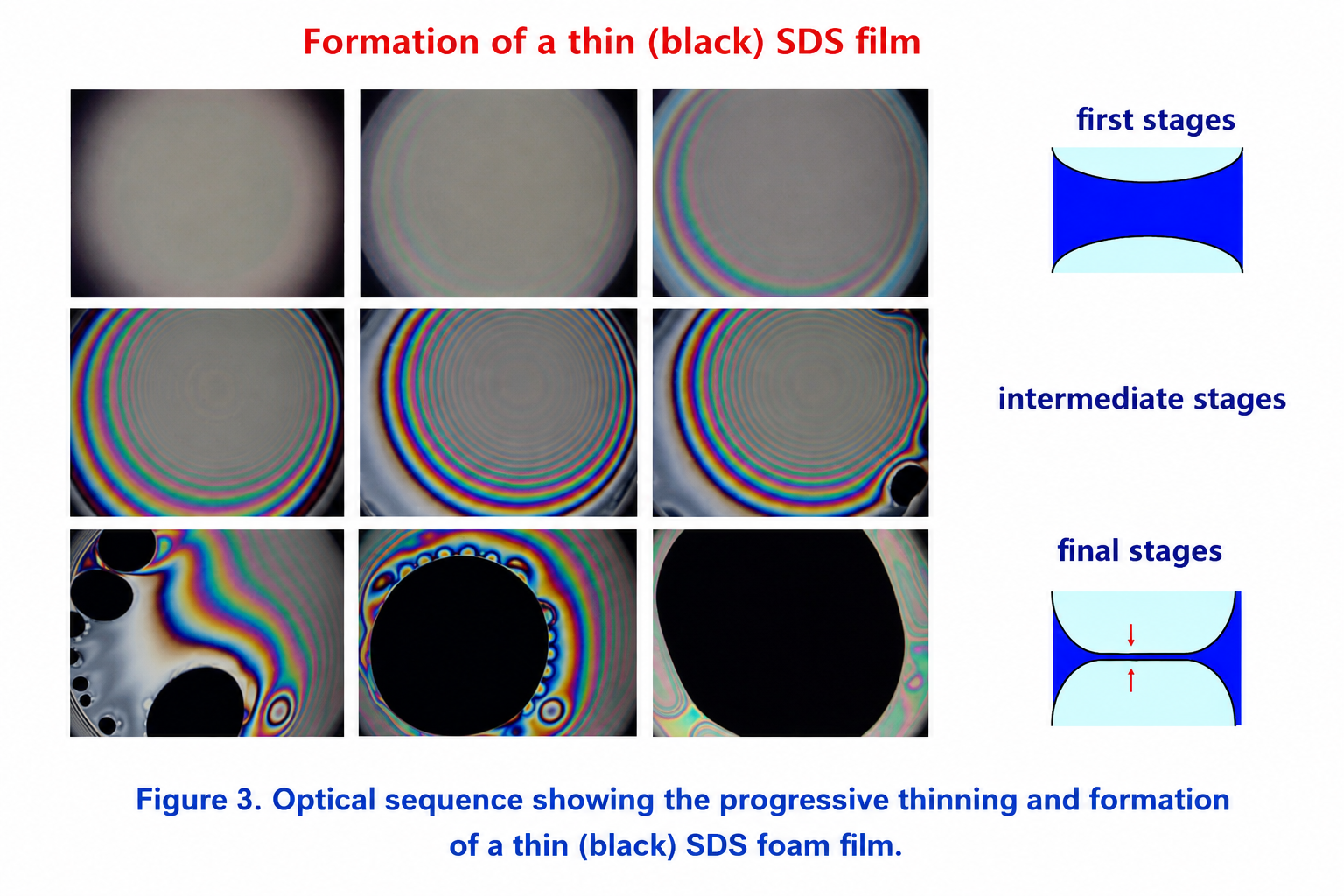
The transition from a thick film to a black film is an optical manifestation of thinning. Interference colors disappear as thickness falls below the range producing visible reflected-light interference, giving rise to the historical term black film. [P1, P2, 1, 2]
03 · Interfacial forces
Disjoining pressure and equilibrium film thickness
When a liquid film becomes sufficiently thin, the two interfaces interact. The resulting interaction is expressed through the disjoining pressure Π(h), defined as the excess normal pressure associated with the film at thickness h relative to a bulk liquid layer. At equilibrium, this interaction pressure balances the externally imposed capillary pressure. [P1, P3, 1, 2, 7]
Film pressure balance
A stable film thickness corresponds to an intersection of the disjoining-pressure isotherm with the imposed pressure that is mechanically stable against small thickness perturbations. [P1, P3, 1, 2]
The classical DLVO description combines van der Waals attraction and electrostatic double-layer repulsion. The Miller lecture explicitly introduces the contributions of Derjaguin, Landau, Verwey and Overbeek and uses primary and secondary minima to connect interaction potentials with stable and metastable film states. [P1, P3, 1, 2, 6]
Conceptual DLVO decomposition
At nanometer thicknesses, hydration, steric, structural and specific-ion forces can become important. Newton black films in particular can enter a regime where short-range interactions are comparable to or larger than the classical diffuse-double-layer contribution. DLVO therefore provides a foundational framework rather than a complete universal description. [P1, P3, 1, 2, 6]
04 · Pair-interaction studies
Film formation between approaching bubbles
A macroscopic foam contains thousands or millions of interacting bubbles. Isolating one or two interfaces eliminates the structural complexity of the foam network and allows direct observation of the event that ultimately destroys the foam: formation, thinning and rupture of a liquid film between neighboring bubbles. [P1, P2, 1, 2]
The Drop-Bubble Micro Manipulator described by Won, Krägel, Makievski, Javadi, Gochev, Loglio and co-workers uses controlled dosing systems, piezo drives and pressure sensors to position and deform two drops, two bubbles or a drop and a bubble. The two interfaces can be brought together according to a defined approach protocol while geometry, capillary pressure and coalescence are observed. [P1, P2, 4, 1, 2]
As two bubbles approach, the liquid trapped between them is squeezed outward. A dimple forms because drainage from the center is slower than drainage near the film rim. The film subsequently thins. At a critical condition, black spots may nucleate and grow, producing a common or Newton black film, or the film may rupture directly. [P1, P3, 4, 1, 2]
05 · Coalescence & rupture
From film thinning to stabilization or collapse
This sequence - approach, dimple, thinning, black-spot formation, black-film growth and eventual rupture or stabilization - is explicitly highlighted in the Miller foam lecture and provides the microscopic basis of coalescence. [P1, P2, 4, 1, 2]
Coalescence occurs when the film separating two bubbles ruptures and the gas volumes merge. Film rupture can follow progressive thinning or be triggered by defects, particles or local mechanical disturbances. [P1, P2, 4, 1, 2]
Film thickness is one of the most informative microscopic observables. Optical interference permits time-resolved thickness measurements from hundreds of nanometers down toward black-film regimes. The film color sequence reflects the optical path difference between light reflected from the two interfaces. [P1, P2, 1, 2]
Film lifetime is the interval from formation to rupture under a defined pressure, geometry and drainage protocol. It depends on film radius, capillary pressure, bulk viscosity, interfacial mobility, disjoining pressure and the statistical nucleation of voids before rupture. It should not be interpreted as an intrinsic molecular constant. [P1, P3, 3, 6, 1]
References
Scientific literature
- 1.D. Exerowa and P. M. Kruglyakov, Foam and Foam Films: Theory, Experiment, Application, Elsevier, Amsterdam, 1998.
- 2.D. Exerowa, G. Gochev, D. Platikanov, L. Liggieri and R. Miller (Eds.), Foam Films and Foams: Fundamentals and Applications, CRC Press, 2018.
- 3.Khr. Khristov, D. Exerowa and K. Malysa, Proceedings of the 3rd Euroconference on Foams, Emulsions and Their Applications, Delft, 2000.