
01 · Foam drainage
Gravity-driven liquid redistribution
Immediately after foam generation, much of the continuous liquid phase resides in Plateau borders and relatively thick films. Gravity drives liquid downward, while capillary pressure gradients pull liquid through the Plateau-border network. The foam becomes progressively drier. [P1, P2, 1, 2, 7]
Drainage changes the geometry and therefore the mechanical state of the foam. As the liquid fraction decreases, films thin and the capillary pressure increases. The probability that a local film reaches a critical rupture state therefore grows even when the molecular composition of the adsorption layer remains unchanged. [P2, P4, 8, 1, 2]
02 · Drainage descriptor
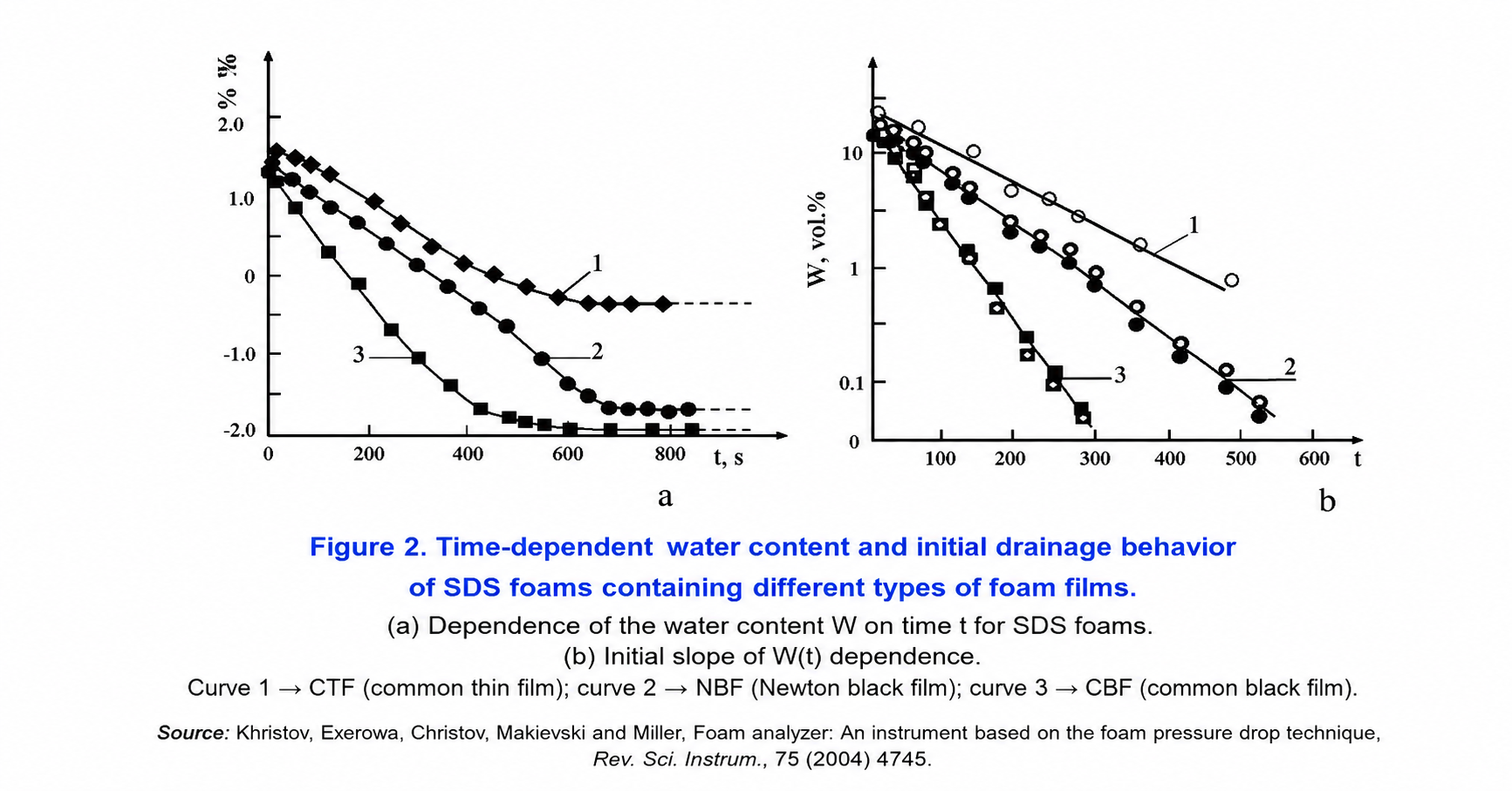
Water content as a function of time
The time-dependent liquid or water content W(t) is a direct experimental measure of drainage. The initial slope of W(t) provides a convenient comparative drainage rate. The FA1 work of Khristov, Exerowa, Christov, Makievski and Miller uses precisely this quantity to compare foams formed from different surfactant systems. [P1, P2, 3, 6, 1]
Initial drainage descriptor
The sign convention is chosen so that a larger positive D0 corresponds to faster liquid loss. It is not a universal material constant because the result depends on foam geometry, bubble size, applied pressure and the foam-generation protocol. [P1, P2, 1, 2, 7]
03 · Film structure
Drainage depends on the type of foam film
The lecture material compares water-content curves for SDS foams associated with common thin films, common black films and Newton black films. The observation is important because macroscopic drainage is not independent of film structure. Changes in disjoining pressure and equilibrium thickness alter how liquid is distributed between films and Plateau borders. [P1, P3, 1, 2, 6]
Three classical film states are distinguished: common thin film (CTF), common black film (CBF) and Newton black film (NBF). Their thickness and stability reflect a balance between capillary pressure and surface forces acting across the film. [P1, P3, 1, 2, 6]
04 · Foam lifetime
A protocol-dependent quantity
The phrase terminus foam lifetime is often used as though it were an intrinsic property of a formulation. In reality, lifetime is the time required to reach a defined collapse criterion under a defined mechanical state. A wet foam at low capillary pressure can persist for a long period while the same formulation collapses rapidly after drainage has increased the capillary stress. [P1, P2, 3, 6, 1]
The endpoint may be first local rupture, loss of a given percentage of foam volume, disappearance of a continuous foam layer or complete collapse. These endpoints are not equivalent. [P1, P2, 3, 6, 1]
Pressure-drop analysis is scientifically valuable because it makes this dependence explicit. Rather than hiding capillary stress inside an uncontrolled aging process, the method introduces pressure as an experimental coordinate. Foam stability can then be represented as lifetime versus pressure, while drainage is measured separately through water-content evolution. [P1, P2, 3, 6, 1]
05 · Macroscopic stability
Liquid fraction defines the physical state of the foam
Liquid fraction controls whether a foam behaves as a wet dispersion of nearly spherical bubbles or as a dry network of polyhedral bubbles. In the wet state, neighboring bubbles can be separated by relatively thick liquid regions. As drainage proceeds, the contact area between neighboring bubbles grows and true foam films become more prominent. The same sample therefore passes through different structural regimes during a single stability experiment. [P1, P2, 1, 2, 7]
Water-content curves provide a quantitative record of this structural evolution. Their initial slope captures early drainage, whereas the later curve reflects the increasing resistance of the Plateau-border network and the changing film contribution. A single drainage constant may be useful empirically, but the full W(t) function contains more mechanistic information. [P1, P2, 3, 6, 1]
Foam volume alone cannot distinguish a wet foam from a dry foam. Because drainage is a central aging mechanism, liquid fraction or water content should be measured whenever stability is interpreted mechanistically. [P1, P2, 3, 6, 1]
References
Scientific literature
- 1.D. Exerowa and P. M. Kruglyakov, Foam and Foam Films: Theory, Experiment, Application, Elsevier, Amsterdam, 1998.
- 2.D. Exerowa, G. Gochev, D. Platikanov, L. Liggieri and R. Miller (Eds.), Foam Films and Foams: Fundamentals and Applications, CRC Press, 2018.
- 3.Khr. Khristov, D. Exerowa, L. Christov, A. V. Makievski and R. Miller, Foam analyzer: An instrument based on the foam pressure drop technique, Review of Scientific Instruments 75 (2004).