
01 · Interfacial mechanics
Curvature, capillary pressure and the Young–Laplace equation
A curved interface sustains a pressure difference between its two sides.
Mechanical equilibrium requires this pressure difference to be balanced by interfacial tension acting through curvature.
For an interface with principal radii of curvature R₁ and R₂, the Young–Laplace equation gives the capillary pressure Δp.
02 · Young–Laplace equation
Pressure difference, curvature and interfacial tension
Young–Laplace equation
The sign convention depends on the definition of pressure difference and interface normal; the magnitude is governed by the sum of principal curvatures.
03 · Spherical interfaces
The Young–Laplace relation for a sphere
For a sphere, R₁ = R₂ = R and the expression simplifies to Δp = 2γ/R.
Spherical interface
Small bubbles or drops can therefore exhibit large capillary pressures.
This simple relation underlies phenomena ranging from bubble stability to porous-media capillarity, but the general axisymmetric equation is required for profile analysis of pendant or sessile drops distorted by gravity.
04 · Drop shape
Competition between interfacial tension and gravity
The shape of a millimetric drop results from competition between interfacial tension, which tends to minimize area, and gravity, which deforms the drop.
The density difference Δρ between the phases and gravitational acceleration g determine the hydrostatic pressure variation with height.
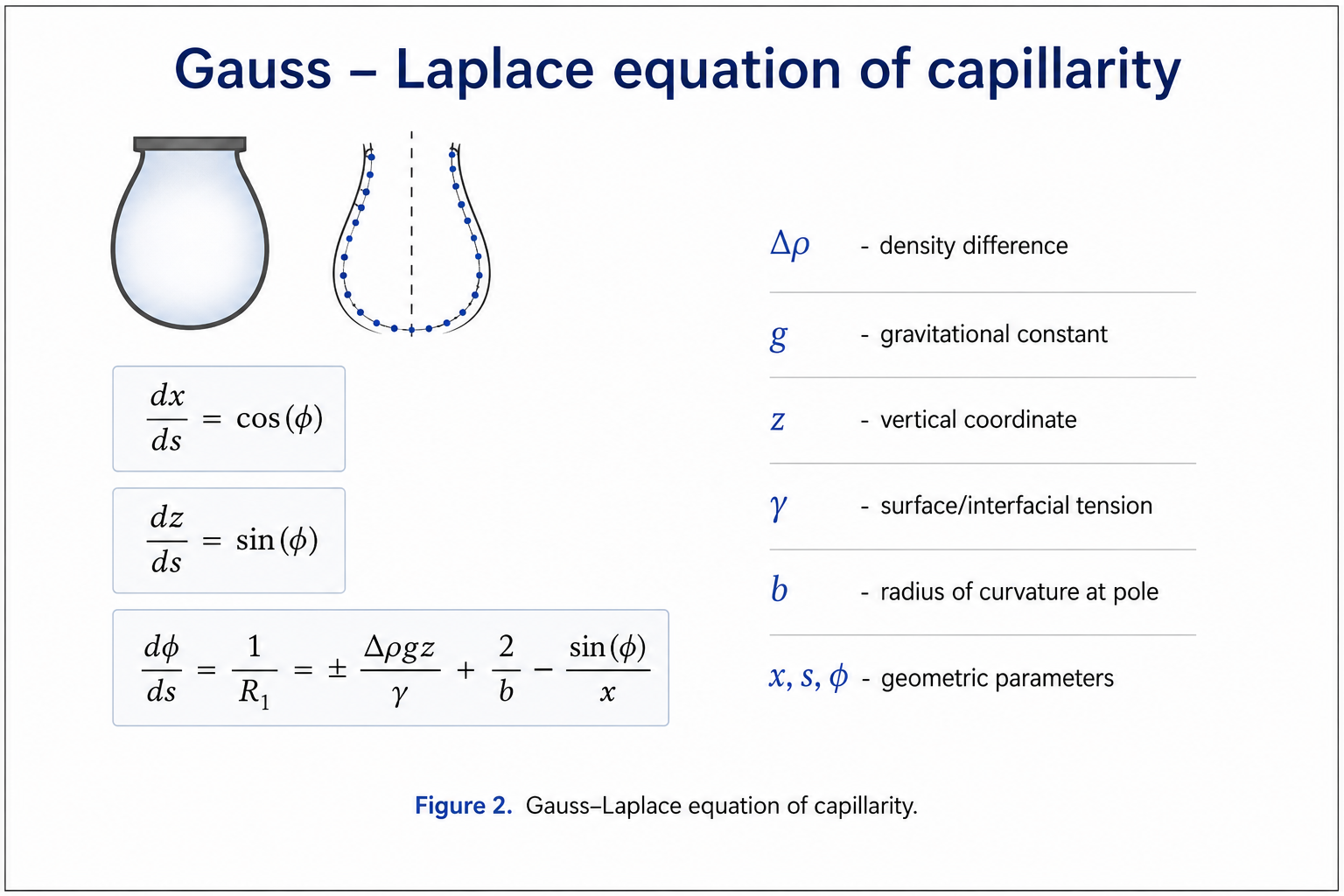
By fitting an experimentally measured drop contour to the numerical solution of the Young–Laplace equation, γ can be inferred from the entire profile rather than from a single geometric feature.
Hydrostatic coupling in an axisymmetric profile
The curvature varies along the contour because pressure changes with vertical coordinate z.
05 · Density difference
Why density difference matters
The gravitational deformation that contains information about γ scales with Δρ.
In liquid–liquid systems with very small density differences, pendant-drop deformation may be weak even when the optical profile is excellent.
Alternative geometries or capillary-pressure approaches can then become advantageous.
07 · References
Scientific literature
- 1.T. Young, An Essay on the Cohesion of Fluids, Philosophical Transactions of the Royal Society of London 95 (1805) 65–87.
- 2.P. S. Laplace, Traité de Mécanique Céleste, Supplement to Book X, Paris, 1805.
- 3.A. I. Rusanov and V. A. Prokhorov, Interfacial Tensiometry, Studies in Interface Science, Vol. 3, Elsevier, Amsterdam, 1996.
- 4.D. Möbius and R. Miller (Eds.), Drops and Bubbles in Interfacial Research, Studies in Interface Science, Vol. 6, Elsevier, Amsterdam, 1998.