
01 · Thermodynamics
Interfacial tension as excess Gibbs free energy
Consider a system containing an interface of area A. When the area is increased reversibly while temperature, pressure and component amounts are constrained, additional free energy must be supplied.
The proportionality coefficient is the interfacial tension. In differential form, the interfacial contribution augments the usual Gibbs fundamental equation by a term γdA.
For a multicomponent system, chemical-potential terms account for changes in composition.
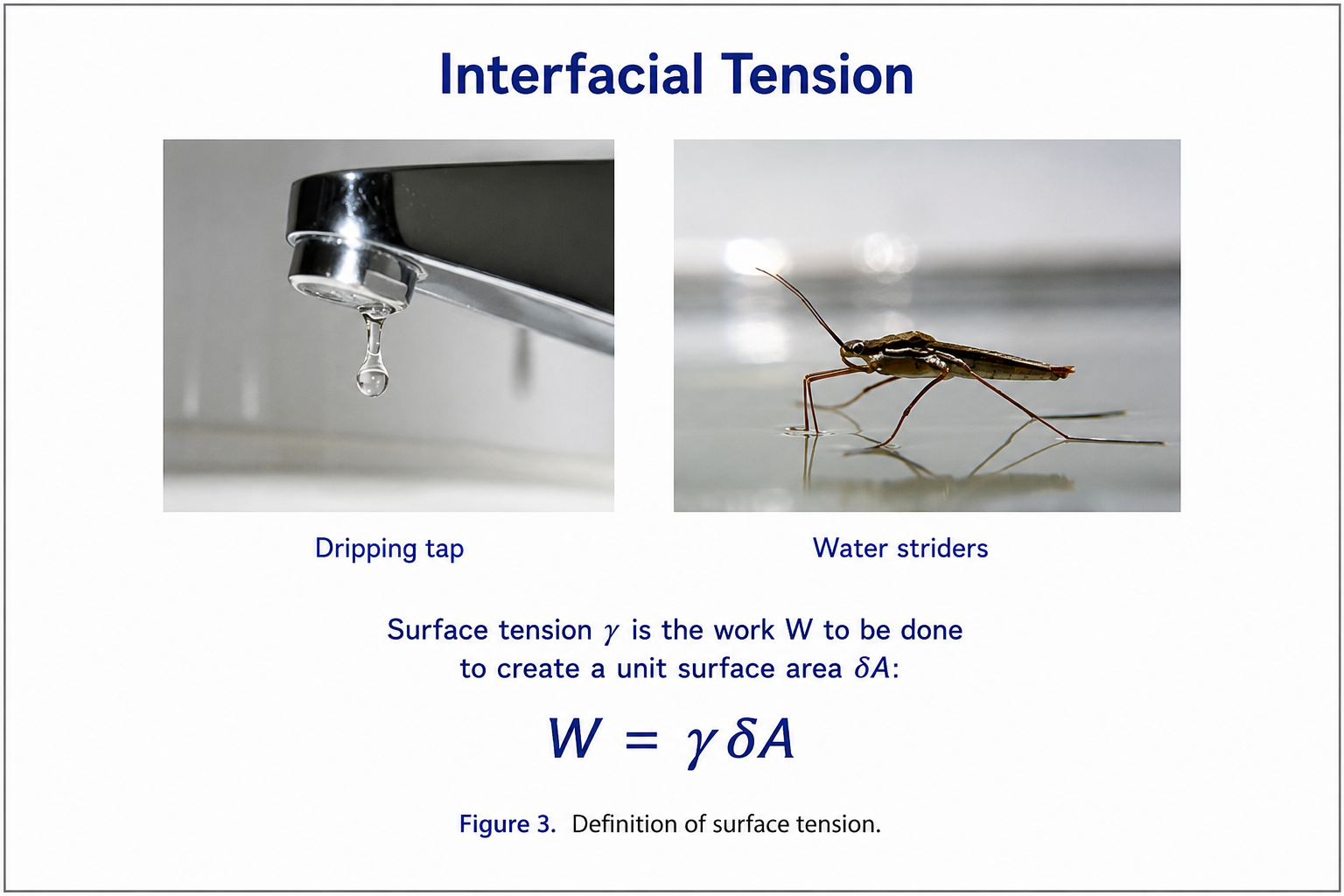
02 · Thermodynamic definition
The energetic cost of creating interfacial area
Thermodynamic definition
For a reversible change of interfacial area at constant temperature, pressure and amounts of all components.
03 · Interfacial state
A defined thermodynamic state
This formulation clarifies several points. First, surface tension is not merely an empirical force parameter; it is a free-energy density.
Second, the value is associated with a defined thermodynamic state.
Third, if the interface changes composition when its area changes, the apparent response can contain both mechanical and adsorption contributions.
This becomes central in dilational interfacial rheology.
04 · Surface pressure
Surface pressure and adsorption layers
Surface pressure is often used when discussing adsorption layers.
It is defined relative to a reference interface, typically the clean solvent surface, as π = γ₀ − γ.
Increasing adsorption of a surface-active solute generally lowers γ and therefore increases π.
This transformation is convenient because many equations of state for adsorption layers resemble two-dimensional pressure relations.
Surface pressure
γ₀ denotes the tension of the reference solvent interface and γ that of the solution.
05 · Gibbs dividing surface
The Gibbs dividing surface and surface excess
A real interface has finite thickness.
Gibbs introduced an idealized mathematical dividing surface that allows the total amount of each component to be decomposed into bulk contributions plus a surface excess.
The surface excess concentration Γᵢ has units of amount per interfacial area.
Its numerical value depends on the convention used to position the dividing surface, but measurable thermodynamic relationships are constructed such that the physical predictions remain well defined.
07 · References
Scientific literature
- 1.J. W. Gibbs, The Collected Works of J. Willard Gibbs, Vol. 1: Thermodynamics, Longmans, Green and Co., 1928.
- 2.A. I. Rusanov and V. A. Prokhorov, Interfacial Tensiometry, Studies in Interface Science, Vol. 3, Elsevier, Amsterdam, 1996.
- 3.V. B. Fainerman, D. Möbius and R. Miller (Eds.), Surfactants: Chemistry, Interfacial Properties, Applications, Studies in Interface Science, Vol. 13, Elsevier, Amsterdam, 2001.
- 4.R. Miller and L. Liggieri (Eds.), Bubble and Drop Interfaces, Progress in Colloid and Interface Science, Vol. 2, 2011.