
01 · Fundamentals
Interfacial tension
Surface tension normally denotes a liquid–gas interface; interfacial tension is the corresponding quantity at an interface between two condensed liquid phases.
The terminology depends on the adjacent phases. “Surface tension” is generally reserved for a liquid in contact with a gas, most commonly air or a controlled vapor phase. “Interfacial tension” is the broader expression and is particularly used for liquid–liquid boundaries such as water–oil interfaces.
02 · Liquid–liquid interfaces
Surface tension versus interfacial tension
The term surface tension is conventionally used when one phase is a gas, usually air or the vapor of the liquid. Interfacial tension refers to the boundary between two condensed phases, most commonly two immiscible liquids such as water and oil.
Both quantities have the same thermodynamic meaning and the same unit. Their magnitudes differ because they depend on the contrast in molecular interactions across the boundary.
Water has a relatively high surface tension because hydrogen bonding and strong cohesive interactions make the transfer of molecules to the surface energetically expensive. At a water–hydrocarbon interface, however, molecules on both sides provide attractive interactions, so the energetic penalty is typically lower than at the water–air surface.
If two liquids become increasingly similar in polarity and cohesive energy density, their interfacial tension tends to decrease; close to a critical solution temperature it can approach zero as the distinction between the phases disappears.
03 · Interfacial state
Complexity of liquid–liquid systems
The thermodynamic formalism is the same, but liquid–liquid systems may introduce additional complexity: both phases can be partially mutually soluble in each other and can contain surface-active solutes (impurities), the solute can partition between phases, the density difference may be small, and adsorption can deplete finite drops or bulk reservoirs.
A measured tension belongs to an interfacial state, not merely to a liquid name.
Reporting “the surface tension of a surfactant solution” is incomplete unless concentration, temperature and interfacial age are known. For multicomponent systems, preparation history, impurities and the geometry-dependent relation between interfacial area and available bulk volume may also matter.
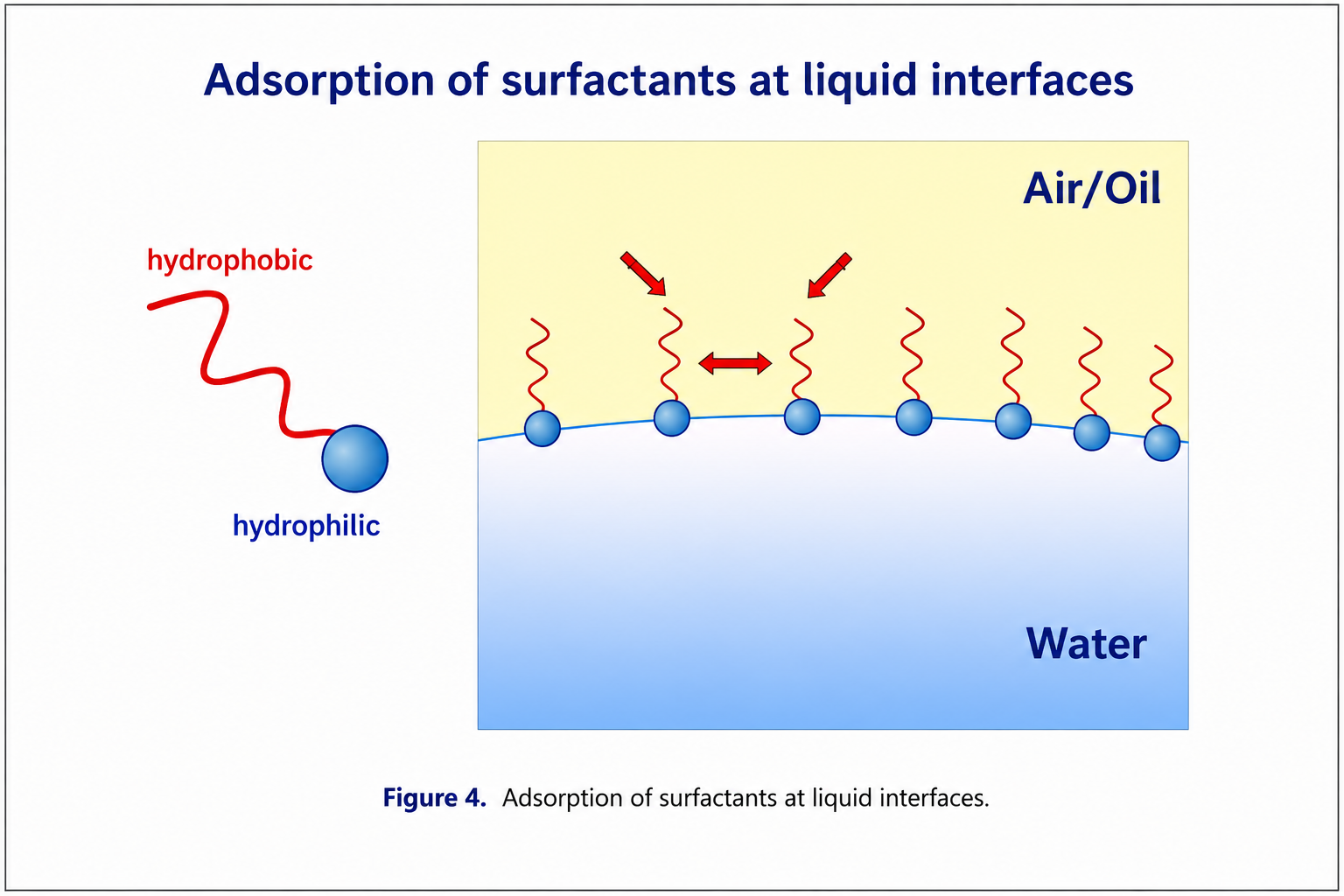
In a multicomponent liquid, molecules that reduce the interfacial free energy preferentially populate the interface. Surfactants provide the canonical example. Their amphiphilic architecture combines chemical groups with different affinities for the adjacent phases, making interfacial localization energetically favorable.
At a water–air interface, a typical surfactant orients its hydrophilic moiety toward water while its hydrophobic moiety avoids the aqueous bulk. At a water–oil interface, both sides offer molecular environments and adsorption can be coupled with partitioning into the oil phase.
05 · References
Scientific literature
- 1.J. W. Gibbs, The Collected Works of J. Willard Gibbs, Vol. 1: Thermodynamics, Longmans, Green and Co., 1928.
- 2.A. I. Rusanov and V. A. Prokhorov, Interfacial Tensiometry, Studies in Interface Science, Vol. 3, Elsevier, Amsterdam, 1996.
- 3.D. Möbius and R. Miller (Eds.), Drops and Bubbles in Interfacial Research, Studies in Interface Science, Vol. 6, Elsevier, Amsterdam, 1998.
- 4.V. B. Fainerman, D. Möbius and R. Miller (Eds.), Surfactants: Chemistry, Interfacial Properties, Applications, Studies in Interface Science, Vol. 13, Elsevier, Amsterdam, 2001.
- 5.R. Miller and L. Liggieri (Eds.), Bubble and Drop Interfaces, Progress in Colloid and Interface Science, Vol. 2, 2011.