
01 · Film formation
A liquid layer confined between two interfaces
A thin liquid film is formed when two fluid interfaces approach sufficiently closely that only a relatively small liquid layer remains between them. In foams, this occurs between neighboring gas bubbles; analogous films occur between approaching droplets in emulsions. [P1, P3, 1, 2]
The film consists of a liquid core bounded by two interfaces. Its subsequent evolution is determined by the removal of liquid from the film, the hydrodynamic conditions within and around it, and the interactions that develop as the two interfaces approach one another. [P1, P3, 1, 2]
02 · Driving force
Capillary pressure drives liquid out of the film
The curved meniscus surrounding a thin film creates a pressure difference. This capillary pressure provides the principal driving force for drainage of liquid from the film toward the surrounding meniscus. [P1, P3, 1, 2]
Young–Laplace relation
The magnitude of the capillary pressure depends on surface tension and interfacial curvature. As drainage proceeds and the film becomes thinner, interaction forces between the opposing interfaces increasingly influence the pressure balance. [P1, P3, 1, 2]
03 · Hydrodynamics
Progressive thinning through liquid drainage
During drainage, liquid is displaced from the central film region toward the surrounding meniscus. Hydrodynamic resistance increases as the film becomes thinner, so the thinning rate generally decreases strongly with decreasing film thickness. [P1, P3, 1, 2]
Drainage is not necessarily spatially uniform. A dimple can develop in the center of the film because liquid near the film rim is removed more rapidly than liquid from the central region. The resulting thickness profile evolves continuously during drainage. [P1, P3, 1, 2]
Consequently, a single film-thickness value cannot always describe the complete state of a draining film. Spatially resolved observation provides additional information about dimples, local thinning and the development of very thin regions. [P1, P3]
04 · Interfacial properties
Drainage depends on more than bulk viscosity
Film drainage is strongly influenced by the mobility of the two interfaces. A mobile interface permits tangential motion, whereas adsorption layers and surface-tension gradients can partially immobilize the interface and increase resistance to drainage. [P1, P3, 1, 2]
Surfactant redistribution during deformation can generate surface-tension gradients and corresponding Marangoni stresses. These stresses oppose interfacial motion and can slow the drainage process. [P1, P3, 1, 2]
Film drainage therefore links hydrodynamics directly with adsorption dynamics and interfacial rheological properties. Systems with similar equilibrium surface tension can still exhibit different drainage behavior when their interfacial dynamics differ. [P1, P3]
05 · Optical measurement
Interference reveals the evolution of film thickness
Reflections from the two interfaces of a thin liquid film interfere with one another. The resulting reflected-light intensity and interference colors therefore contain information about the optical thickness of the film. [P1, P3, 1, 2]
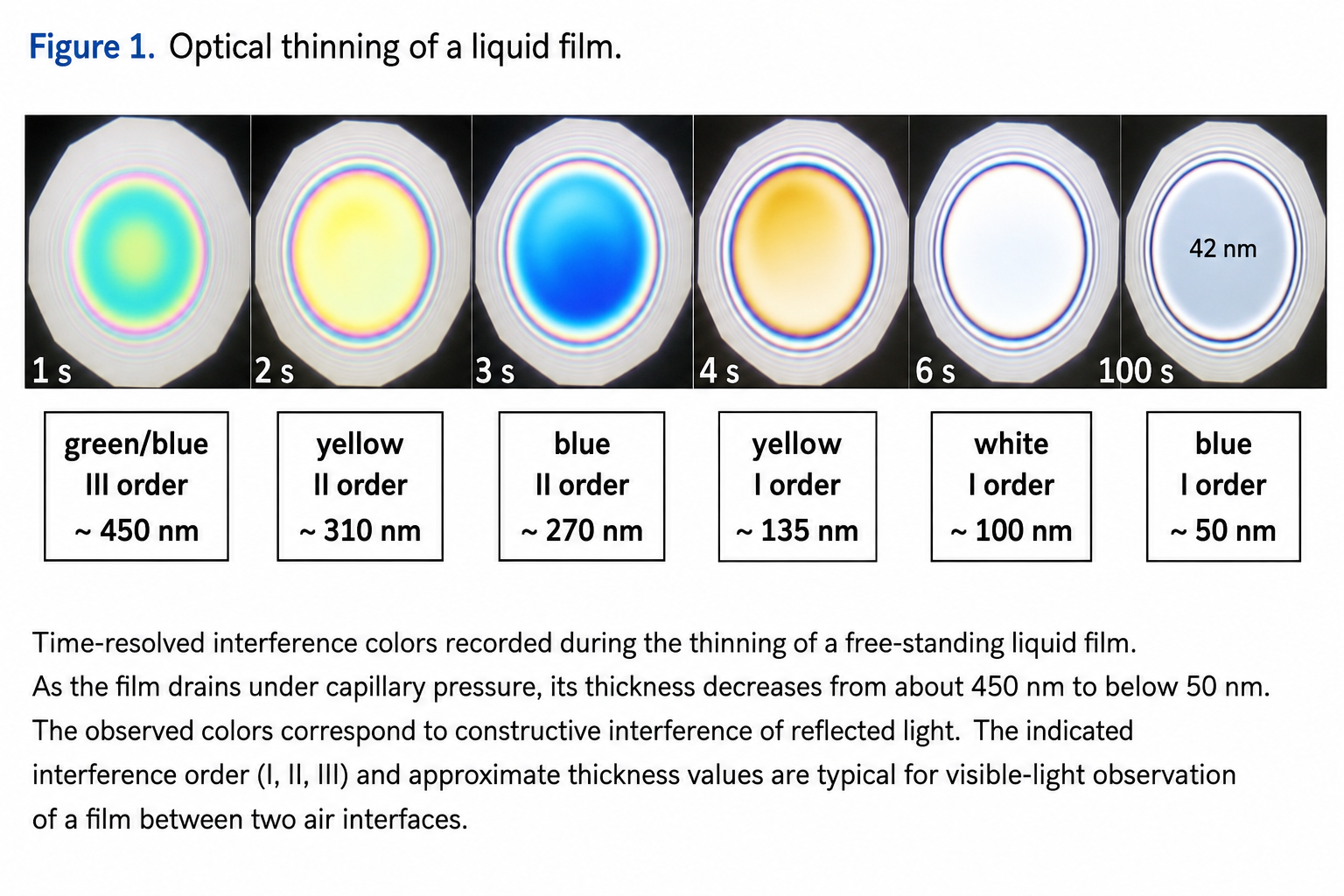
Time-resolved optical observation can therefore follow film thinning from relatively thick interference-colored states toward much thinner states. At sufficiently small thickness, visible interference colors disappear and the film can appear black in reflected light. [P1, P3, 1, 2]
Thickness as a function of time provides a direct experimental description of drainage kinetics. Combined with controlled pressure and geometry, such measurements form the basis for quantitative characterization of thin-film dynamics. [P1, P3]
References
Scientific literature
- 1.D. Exerowa and P. M. Kruglyakov, Foam and Foam Films: Theory, Experiment, Application, Elsevier, Amsterdam, 1998.
- 2.D. Exerowa, G. Gochev, D. Platikanov, L. Liggieri and R. Miller (Eds.), Foam Films and Foams: Fundamentals and Applications, CRC Press, 2018.