
01 · Interfacial forces
Interaction between the two bounding interfaces
At large film thickness, the two interfaces of a liquid film behave approximately independently. As the film becomes thinner, their interaction fields begin to overlap and the film develops properties that cannot be represented by two isolated surfaces. [P1, P3, 1, 2]
This interaction is described through the disjoining pressure Π(h), which expresses the normal interaction pressure between two interfaces separated by a film of thickness h. [P1, P3, 1, 2]
Thermodynamic definition
The complete dependence of disjoining pressure on film thickness is described by the disjoining-pressure isotherm. It provides a quantitative connection between intermolecular surface forces and experimentally observed film thickness. [P1, P3, 1, 2]
02 · Equilibrium
Capillary pressure balanced by disjoining pressure
In an equilibrium free liquid film, the interaction pressure acting across the film balances the capillary pressure imposed by the surrounding meniscus or experimental film holder. [P1, P3, 1, 2]
Equilibrium pressure balance
The equilibrium thickness h_eq therefore depends on the full interaction-pressure relation rather than on surface tension alone. Changing the imposed pressure can shift the film to a different stable thickness or induce a transition between distinct film states. [P1, P3, 1, 2]
Pressure-balance measurements consequently provide a direct experimental route to surface-force characterization in thin-film geometry. [P1, P3]
03 · DLVO theory
Electrostatic repulsion and van der Waals attraction
Classical DLVO theory describes the interaction between charged interfaces as the combination of attractive van der Waals forces and repulsive electrostatic double-layer forces. [P1, P3, 1, 2]
Classical DLVO contribution
Electrostatic repulsion arises when diffuse electrical double layers overlap as the two interfaces approach. Its range and magnitude depend strongly on surface charge and electrolyte concentration. [P1, P3, 1, 2]
Van der Waals attraction acts in the opposite direction and promotes further thinning. The competition between attraction and repulsion can generate barriers and minima in the interaction potential. [P1, P3, 1, 2]
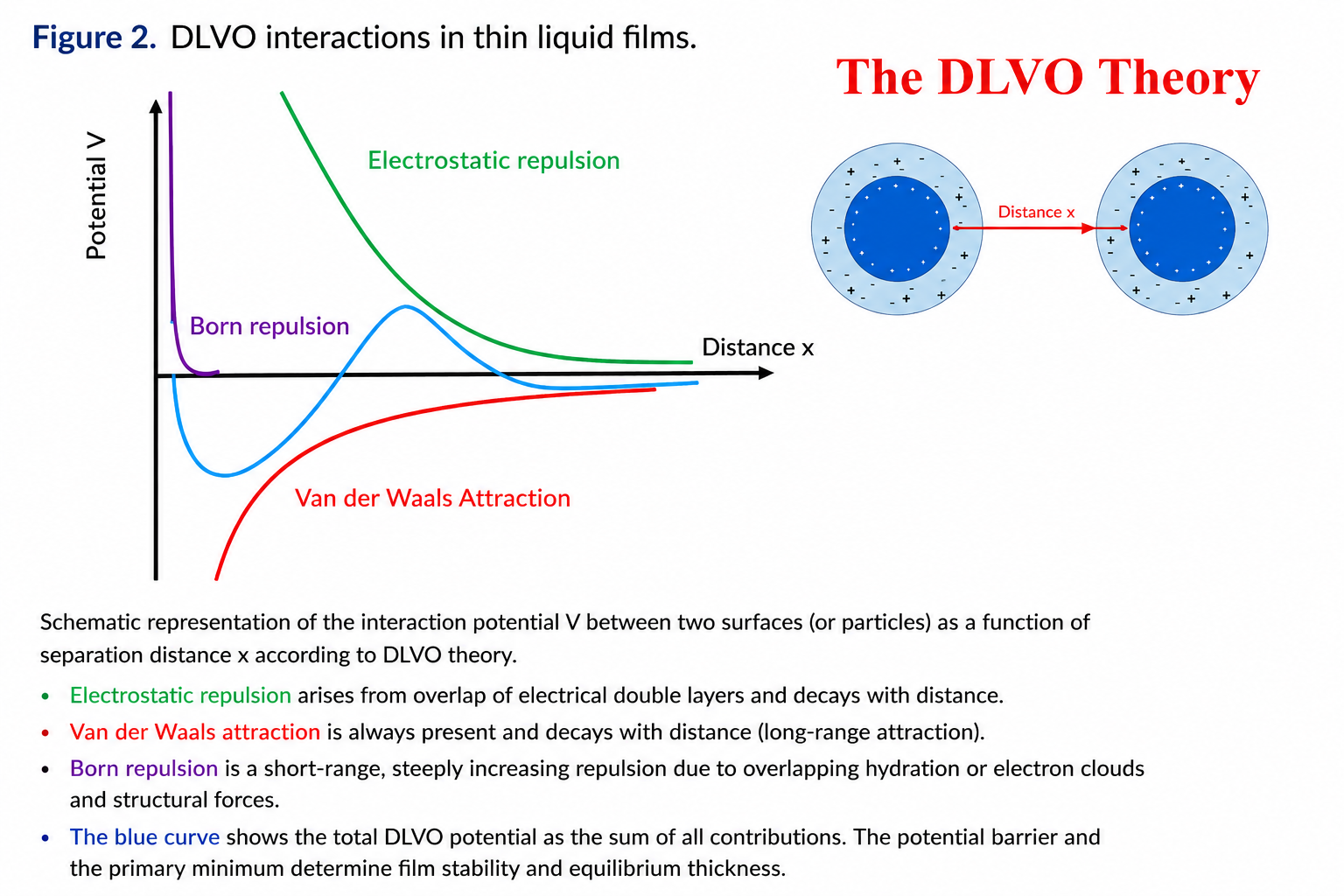
The resulting interaction profile explains why some films remain separated at relatively large thickness whereas others can move toward much thinner equilibrium states. [P1, P3, 1, 2]
04 · Short-range interactions
Classical DLVO theory is not always sufficient
At very small film thicknesses, additional interaction forces can become important. Hydration forces, steric interactions, structural forces and specific-ion effects may contribute to the stability of molecularly thin films. [P1, P3, 1, 2]
These short-range contributions are particularly relevant for Newton black films, where the separation between the two adsorption layers is only several nanometers and classical diffuse-double-layer concepts alone may not describe the observed stability. [P1, P3, 1, 2]
The experimentally measured disjoining-pressure isotherm therefore contains the combined effect of all interaction mechanisms acting across the film, regardless of whether they originate from classical DLVO or additional non-DLVO forces. [P1, P3]
05 · Equilibrium states
Common thin, common black and Newton black films
Thin foam films can exist in several characteristic thickness states. The classical classification distinguishes common thin films (CTF), common black films (CBF) and Newton black films (NBF). [P1, P3, 1, 2]
A common thin film remains relatively thick and can display visible interference colors. At smaller thickness, a common black film can form, while Newton black films represent still thinner states in which short-range molecular interactions become especially important. [P1, P3, 1, 2]
Transitions between these states are governed by the interaction-pressure isotherm together with the imposed capillary pressure. A film may remain on one equilibrium branch until that state loses stability and the system jumps to another thickness. [P1, P3, 1, 2]
The distinction between these film states is central to the interpretation of foam-film stability because different thickness regimes correspond to different balances of interfacial forces. [P1, P3, 1, 2]
References
Scientific literature
- 1.D. Exerowa and P. M. Kruglyakov, Foam and Foam Films: Theory, Experiment, Application, Elsevier, Amsterdam, 1998.
- 2.D. Exerowa, G. Gochev, D. Platikanov, L. Liggieri and R. Miller (Eds.), Foam Films and Foams: Fundamentals and Applications, CRC Press, 2018.