
01 · Interfacial mechanical response
Elastic and viscous contributions
A fluid interface can possess mechanical properties that are not evident from its equilibrium tension alone. When surface-active molecules adsorb, the interface becomes a two-dimensional thermodynamic subsystem with its own composition and structure. If the interfacial area is changed, the adsorbed molecules are diluted expanded or compressed. If the interface is sheared, lateral structures are distorted. The resulting resistance to deformation can be elastic, viscous or a combination of both. [P1, 10, 11]
This mechanical response is referred to as interfacial rheology or surface rheology. It is the two-dimensional analogue of bulk rheology, but the analogy must be used carefully. An interface has no unique macroscopic thickness, and its constitutive behavior can be coupled strongly to adsorption and diffusion in the adjacent phases. An apparent interfacial viscosity can therefore contain a contribution from molecular exchange between interface and bulk rather than representing only friction within a geometrically defined film. [P1, 4, 5, 1]
02 · Storage and loss
Complex dilational response
For small harmonic area perturbations, the dilational response is represented by a complex modulus. The real part is the storage component and represents the in-phase elastic response. The imaginary part is the loss component and represents the out-of-phase dissipative response. The corresponding dilational viscosity is obtained from the loss modulus divided by angular frequency. [P1, 4, 5, 2]
Complex dilational modulus
The real part E′ is the storage modulus and represents the component of the response in phase with deformation. It quantifies reversible storage of mechanical energy. The imaginary part E″ is the loss modulus and represents the component shifted by ninety degrees in the idealized linear decomposition. It quantifies energy dissipated during a cycle. [P1, 1, 2, 4]
Magnitude and phase
Dilational viscosity
03 · Molecular origin
Restoring stress and dissipative mechanisms
Consider an adsorption layer at equilibrium. A rapid expansion lowers the surface excess Γ because the same adsorbed amount is distributed over a larger area. The tension rises toward the value of a less populated interface. This creates a restoring surface-pressure gradient. If the deformation is slow, additional molecules can adsorb from the bulk and reduce the change in tension. The measured modulus therefore depends on how much molecular exchange occurs during the cycle. [P1, 1, 14]
A compression produces the reverse sequenceprocess. The interface is temporarily enriched; tension decreases and molecules can desorb. In a perfectly insoluble monolayer, no exchange occurs and the elastic response is governed by the interfacial equation of state. In a soluble monolayer, exchange relaxes part of the stress. [P1]
Energy can be dissipated through several channels. Molecules can diffuse between bulk and interface, reorganize within the adsorption layer, move laterally through a viscous interfacial environment or undergo conformational changes. Bulk hydrodynamics around the oscillating interface also dissipate energy and must be separated from the interfacial contribution by the analysis model. [P1, 1, 14]
04 · Frequency dependence
The Lucassen–van den Tempel concept
The characteristic feature of interfacial dilational rheology is frequency dependence. At low oscillation frequency, each cycle lasts long enough for substantial adsorption and desorption. The interfacial composition therefore remains closer to equilibrium and the restoring tension change is relatively small. As frequency increases, exchange with the bulk cannot keep pace with the imposed deformation. The interface behaves progressively more like an insoluble layer and the elastic response increases. [P1, 4, 5, 1]
The Miller lecture material states this directly: the dynamic surface elasticity increases with angular frequency and approaches a limiting modulus at sufficiently high frequency. The limiting value corresponds to the response of the surface layer when interfacial composition is effectively frozen over the period of deformation. [P1, 4, 5, 2]
Angular frequency
Lucassen and van den Tempel developed the classical treatment linking the complex dilational modulus of a soluble adsorption layer to diffusion in the adjoining bulk. Their theory formalizes the intuitive competition between oscillation period and diffusion time. A periodic perturbation generates an oscillating concentration field normal to the interface. The depth over which molecules can respond decreases as frequency increases. [P1, 4, 5, 1]
At low frequency, the diffusion layer extends farther into the bulk and a comparatively large reservoir can exchange with the interface. At high frequency, only molecules very close to the interface can participate during one cycle. This progressive restriction of mass exchange causes the storage component to rise. [P1, 4, 5, 2]
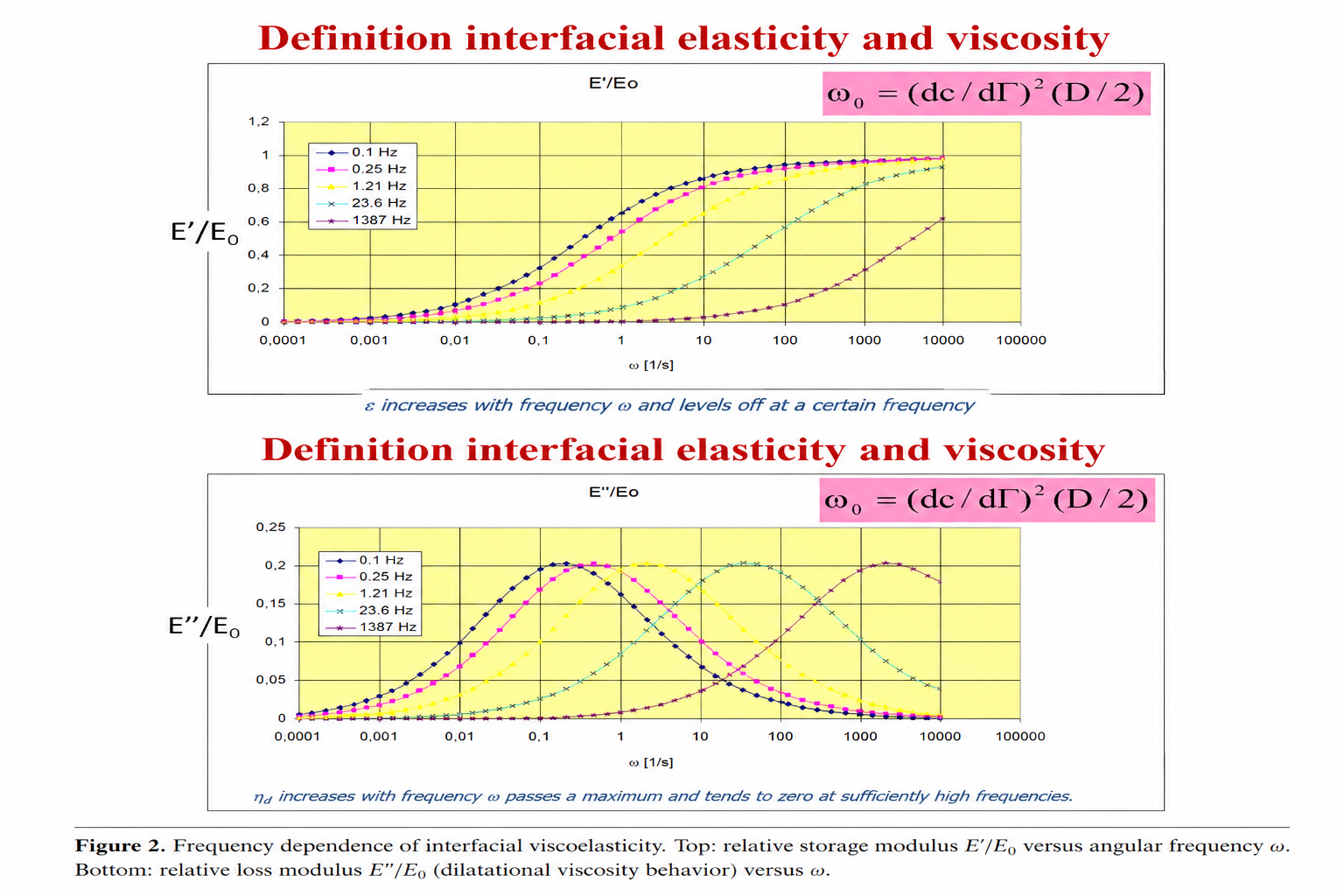
The qualitative frequency dependence shown in the source material is characteristic. The elastic response E′ increases with frequency and levels off toward the limiting high-frequency modulus. The effective dilational viscosity increases over an intermediate range, reaches a maximum and then tends toward zero at sufficiently high frequency when exchange becomes too slow to contribute strongly to dissipation. [P1, 4, 5, 2]
Interpretation. A maximum in apparent dilational viscosity does not necessarily indicate a maximum in molecular friction inside the adsorption layer. In the Lucassen-type picture it can arise from the frequency at which exchange between bulk and interface is most strongly out of phase with the imposed deformation. [P1, 4, 5, 1]
05 · Interfacial state
Composition, structure and age
Frequency dependence is inseparable from composition. A weakly populated interface can exchange rapidly and have a low modulus. Near dense packing, the interfacial equation of state is steeper and the high-frequency elasticity can be much larger. Electrolyte, mixed surfactants, proteins, lipids and polymers alter both the thermodynamic elasticity and the relaxation time. [P1, 4, 5, 1]
For proteins and macromolecules, adsorption can be followed by slow conformational rearrangement. An aged interface can therefore have a different rheological response from a freshly adsorbed layer even if the equilibrium tension appears nearly unchanged. Interfacial age is thus a critical state variable in rheological experiments. [P1, 1, 2, 4]
Because all rheological parameters depend on frequency, a modulus without frequency is incomplete. A full frequency sweep is preferable when the objective is mechanistic understanding. If only one frequency is used, it should be selected to match the relevant physical process and clearly reported. [P1, 4, 5, 1]
References
Scientific literature
- 1.R. Miller and L. Liggieri (Eds.), Interfacial Rheology, Progress in Colloid and Interface Science, Vol. 1, Taylor & Francis, 2009.
- 2.R. Miller and L. Liggieri (Eds.), Bubble and Drop Interfaces, Progress in Colloid and Interface Science, Vol. 2, 2011.
- 3.J. Lucassen and M. van den Tempel, Dynamic measurements of dilational properties of a liquid interface, Chemical Engineering Science 27 (1972) 1283-1291.
- 4.J. Lucassen and M. van den Tempel, Longitudinal waves on visco-elastic surfaces, Journal of Colloid and Interface Science 41 (1972) 491-498.
- 5.B. Aveyard, Surfactants: In Solution, at Interfaces and in Colloidal Dispersions, Oxford University Press, 2019.