
01 · Dilational deformation
Expansion and compression of an adsorption layer
Dilational deformation changes interfacial area. During expansion, a fixed number of adsorbed molecules initially occupies a larger area and the surface concentration decreases. During compression, the surface concentration increases. The resulting change in surface or interfacial tension provides the measurable interfacial stress response. In this and further discussions we assume an essentially homogeneous distribution of adsorbed molecules at the interface, which should hold also during the processes of expansion and compression. [P1, 1, 2, 4]
For a soluble surfactant, the perturbation is not limited to geometric dilution or compression. Expansion lowers the interfacial concentration and can promote adsorption from the bulk; compression increases the interfacial concentration and can promote desorption. The observed response therefore depends on the rate of deformation relative to adsorption and diffusion. [P1, 4, 5, 1]
02 · Dilational elasticity
Interfacial stress and area deformation
For small deformations, dilational strain is commonly expressed as the relative change in area, dA/A, or equivalently d ln A. The conjugate interfacial stress is the change in surface tension dγ. The differential dilational elasticity is therefore the derivative of γ with respect to logarithmic area. [P1, 1, 2, 4]
Dilational elasticity
The sign convention varies in the literature depending on whether surface pressure or surface tension is used. What matters physically is the magnitude and phase of the restoring response to area change. For a compression, surface tension commonly decreases while surface pressure increases. [P1]
03 · Complex modulus
Storage and loss components
In an oscillatory experiment the area is perturbed sinusoidally around a mean value. If the perturbation is sufficiently small for linear response, the tension oscillates at the same fundamental frequency. The tension signal can differ from the area signal in both amplitude and phase. [P1, 4, 5]
Complex dilational modulus
The real part E′ is the storage modulus and represents the component of the response in phase with deformation. It quantifies reversible storage of mechanical energy. The imaginary part E″ is the loss modulus and represents the component shifted by ninety degrees in the idealized linear decomposition. It quantifies energy dissipated during a cycle. [P1, 1, 2, 4]
Dilational viscosity
The dilational viscosity η_d is therefore frequency dependent when E″ is frequency dependent. It should not automatically be interpreted as a constant intrinsic viscosity of the interfacial material. In soluble surfactant layers, a substantial part of the loss response can arise from exchange of molecules with the bulk. [P1, 4, 5, 1]
04 · Frequency dependence
Competition between deformation and adsorption relaxation
The characteristic feature of interfacial dilational rheology is frequency dependence. At low oscillation frequency, each cycle lasts long enough for substantial adsorption and desorption. The interfacial composition therefore remains closer to equilibrium and the restoring tension change is relatively small. As frequency increases, exchange with the bulk cannot keep pace with the imposed deformation. The interface behaves progressively more like an insoluble layer and the elastic response increases. [P1, 4, 5, 1]
The Miller lecture material states this directly: the dynamic surface elasticity increases with angular frequency and approaches a limiting modulus at sufficiently high frequency. The limiting value corresponds to the response of the surface layer when interfacial composition is effectively frozen over the period of deformation. [P1, 4, 5, 2]
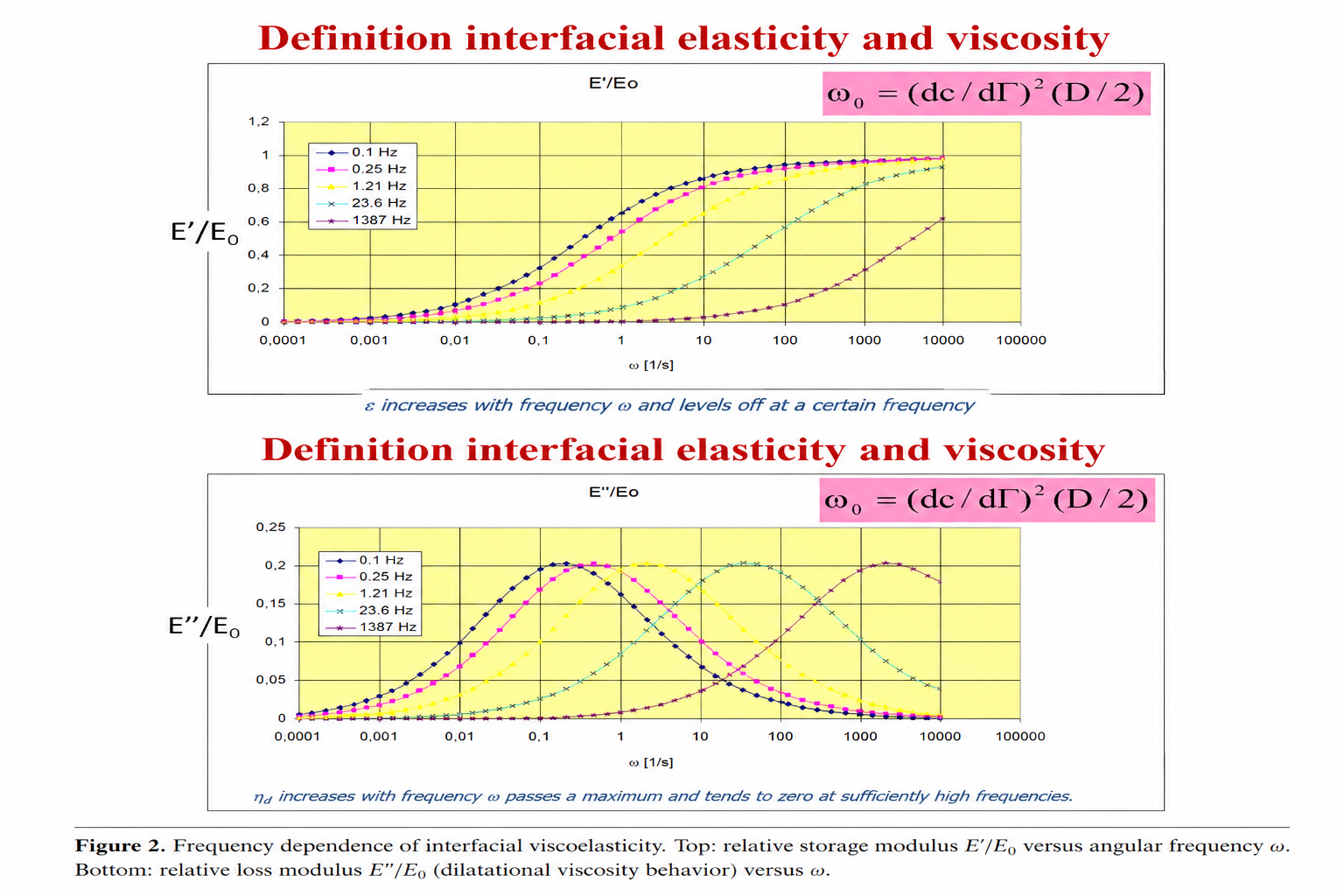
The qualitative frequency dependence shown in the source material is characteristic. The elastic response E′ increases with frequency and levels off toward the limiting high-frequency modulus. The effective dilational viscosity increases over an intermediate range, reaches a maximum and then tends toward zero at sufficiently high frequency when exchange becomes too slow to contribute strongly to dissipation. [P1, 4, 5, 2]
Interpretation. A maximum in apparent dilational viscosity does not necessarily indicate a maximum in molecular friction inside the adsorption layer. In the Lucassen-type picture it can arise from the frequency at which exchange between bulk and interface is most strongly out of phase with the imposed deformation. [P1, 4, 5, 1]
05 · Measurement methods
Choosing a dilational-rheology method
The source lecture presents methods across several frequency decades. Oscillating barriers and profile-based drop or bubble oscillations cover approximately 0.001 to 0.1 Hz. Longitudinal waves cover an intermediate range around 0.1 to 15 Hz. Oscillating drops using capillary-pressure detection can extend to roughly 100 Hz, while oscillating-bubble and capillary-wave techniques can reach several hundred hertz. [P1, 4, 5, 6]
Method selection should be based on the relaxation times of the system. A slowly aging protein film may require millihertz measurements and long equilibration. A low-molecular-weight surfactant may require tens or hundreds of hertz to approach the high-frequency modulus. A liquid-liquid system with nearly matched density is better suited to capillary-pressure detection than to gravitational profile analysis. [P1, 4, 5, 1]
Complementarity. A broad interfacial relaxation spectrum is best measured by overlapping methods. The goal is not to force one technique across every frequency decade, but to verify that different methods describe a consistent physical response in their common range. [P1, 4, 5]
References
Scientific literature
- 1.R. Miller and L. Liggieri (Eds.), Interfacial Rheology, Progress in Colloid and Interface Science, Vol. 1, Taylor & Francis, 2009.
- 2.R. Miller and L. Liggieri (Eds.), Bubble and Drop Interfaces, Progress in Colloid and Interface Science, Vol. 2, 2011.
- 3.J. Lucassen and M. van den Tempel, Dynamic measurements of dilational properties of a liquid interface, Chemical Engineering Science 27 (1972) 1283-1291.
- 4.J. Lucassen and M. van den Tempel, Longitudinal waves on visco-elastic surfaces, Journal of Colloid and Interface Science 41 (1972) 491-498.
- 5.A. Passerone, L. Liggieri, N. Rando, F. Ravera and E. Ricci, Journal of Colloid and Interface Science 146 (1991) 152.