
01 · Advancing and receding
Why a single static angle is insufficient
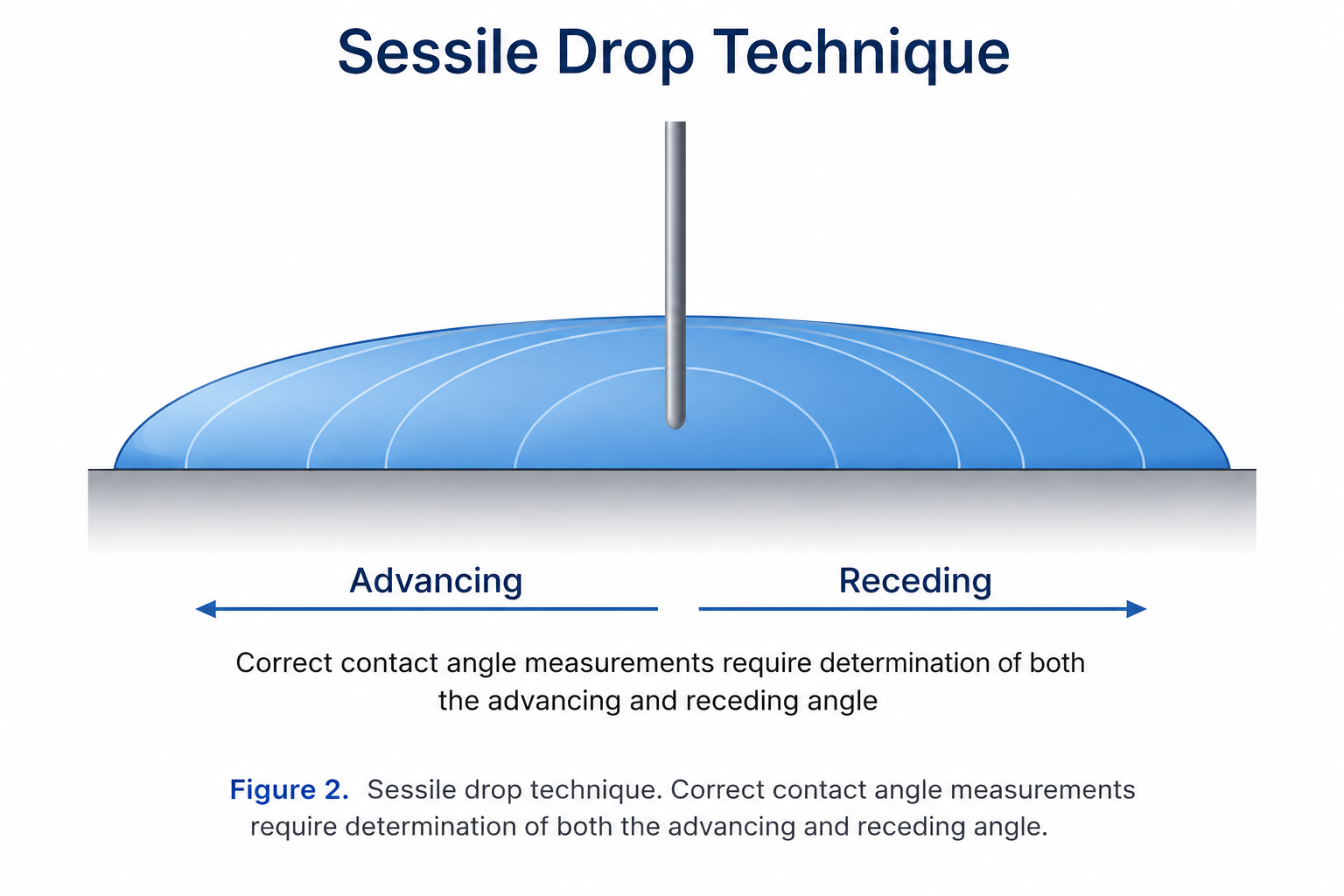
The source lecture is unequivocal that correct contact-angle measurements require determination of both advancing and receding angles. A contact line on a real surface can remain pinned while droplet volume changes. The contact angle then changes without movement of the contact line. Only when a limiting angle is reached does the line advance or recede. [P1, 6, 11, 13]
02 · Advancing angle
Advancing contact angle
The advancing angle θ_A is measured while liquid volume is increased slowly. Initially the footprint may remain fixed while the droplet grows and the angle rises. Once the contact line depins, the footprint expands. The angle maintained during quasisteady outward motion is identified as the advancing contact angle under the specific protocol. According to Neumann, this angle is the thermodynamic contact angle, in contrast to the receding contact angle where the SV interface was partially a SL interface during the experiment with a reducing liquid drop. [P1, 6, 11, 13]
03 · Receding angle
Receding contact angle
The receding angle θ_R is measured while liquid is withdrawn. The footprint can remain pinned as volume decreases and the angle falls. When the contact line begins to retreat, the limiting angle defines the receding angle. [P1, 6, 11, 13]
Contact-angle hysteresis
04 · Hysteresis
Physical origin of hysteresis
Hysteresis is caused by metastability of the contact line. Chemical patches, roughness features, scratches, pores, contamination and microscopic changes in surface chemistry create local energy barriers. The contact line can therefore occupy multiple mechanically stable configurations within an interval of contact angles. [P1, 6, 11, 13]
The hysteresis range contains information that the static angle does not. A surface can have a high apparent water angle but also a very large hysteresis, causing droplets to stick strongly. Conversely, a surface with a similar static angle and low hysteresis can permit easy droplet roll-off. [P1, 6, 11, 13]
05 · Dynamic contact angle
Dynamic contact angle versus advancing and receding limits
Advancing and receding angles are often measured at very low contact-line velocity and treated as quasistatic limits. At finite velocity, the observed dynamic angle can depend on speed through viscous dissipation, microscopic slip and molecular kinetics at the moving contact line. Therefore, measurement rate should be reported rather than assumed irrelevant. [P1, 6, 11, 13]
06 · Contact-line pinning
Contact-line pinning and wetting kinetics
The motion of the three-phase contact line is central to practical wetting. When a droplet volume increases on a pinned footprint, its radius, height and contact angle do not change linearly with volume. The In Miller’s lecture it is explicitly illustratesd that a linear increase in drop volume is accompanied by a nonlinear evolution of the drop radius and contact angle before the 3-phase-contact-line begins to move. [P1, 1, 4, 6]
Pinning converts the equilibrium Young condition into a metastable inequality. Within the hysteresis interval, an imbalance of interfacial forces exists but is insufficient to overcome defect-induced barriers. The contact line moves only when the driving force exceeds the local pinning threshold. [P1, 6, 11, 13]
This picture explains why surface preparation matters so strongly. Polishing, plasma treatment, oxidation, coating, contamination and aging can all modify the density and strength of pinning sites. A contact-angle value without a documented surface-preparation protocol is therefore difficult to compare across laboratories. [P1, 6, 11, 13]
References
Scientific literature
- 1.M. Ferrari, L. Liggieri and R. Miller (Eds.), Drops and Bubbles in Contact with Solid Surfaces, Progress in Colloid and Interface Science, CRC Press, 2013.
- 2.C. Huh and S. G. Mason, effects of surface heterogeneity and contact-line behavior in wetting, Colloid & Polymer Science 253 (1975) 566.
- 3.J. C. Berg (Ed.), Wettability, Surfactant Science Series, Marcel Dekker, 1993.
- 4.A. W. Neumann and J. K. Spelt (Eds.), Applied Surface Thermodynamics, Surfactant Science Series, Vol. 63, Marcel Dekker, 1996.
- 5.D. Möbius and R. Miller (Eds.), Drops and Bubbles in Interfacial Research, Studies in Interface Science, Vol. 6, Elsevier, Amsterdam, 1998.