
00 · Abstract
Abstract
Contact angle measurements provide one of the most widely used experimental routes for characterizing the wetting behavior of solid surfaces. The apparent simplicity of a droplet resting on a substrate conceals a complex three-phase problem involving solid, liquid and vapor interfacial free energies, surface heterogeneity, roughness, contact-line pinning and, in practical formulations, time-dependent adsorption of surface-active species. A contact angle is therefore not an intrinsic property of a solid alone. It is a state variable of a particular solid-liquid-vapor system under a defined preparation history and measurement protocol. [P1, 1, 4, 6]
For an ideal, chemically homogeneous, smooth and rigid solid at equilibrium, the contact angle is described by Young's equation, which expresses the horizontal force balance among the solid-vapor, solid-liquid and liquid-vapor interfacial tensions at the three-phase contact line. This ideal Young angle provides the thermodynamic reference state. Real surfaces rarely satisfy the assumptions exactly. Advancing and receding contact angles are therefore generally different, producing contact-angle hysteresis. The Miller lecture material emphasizes that correct contact-angle characterization requires determination of both advancing and receding values rather than reporting a single static angle. [P1, 1, 4, 6]
Surface roughness adds a second level of complexity. In the Wenzel state, liquid follows the surface topography and the apparent angle is modified by the roughness ratio. In the Cassie-Baxter state, the liquid contacts a composite surface containing solid and trapped gas or a second material. These models provide useful limiting descriptions but are not universal laws for arbitrary roughness. Real surfaces can exhibit metastable wetting states, partial impregnation, wicking and transitions between Cassie-Baxter-like and Wenzel-like configurations. [P1, 2, 3, 4]
The experimental methods reviewed here follow the structure of Miller's lecture 'Contact Angles & Wettability'. Sessile-drop analysis is the principal optical technique for planar surfaces and can be applied to liquid-gas-solid and liquid-liquid-solid systems. Dynamic measurements during controlled drop volume increase and decrease yield advancing and receding angles and reveal contact-line pinning. Plate-immersion methods infer wetting from force while a solid enters or leaves a liquid, and the Washburn method extends contact-angle analysis to powders and porous beds through capillary uptake. [P1, 6, 11, 13]
A further central theme is the distinction between wetting of pure liquids and wetting by surfactant solutions. When a surfactant solution spreads on a solid, the liquid-vapor, solid-liquid and solid-vapor interfacial tensions can all evolve with concentration and time. Consequently, the contact angle and spreading kinetics become dynamic quantities. Miller, Dutschk and Fainerman explicitly linked molecular processes at liquid interfaces to dynamic surface tensions and wetting kinetics. Equilibrium contact-angle theories remain important, but practical interpretation requires the time dependence of all participating interfaces. [P1, 7, 12, 4]
This review develops the thermodynamic foundations, experimental procedures and principal interpretation frameworks for contact angle and wetting phenomena. The primary scientific basis is Miller’s lecture material, supplemented by the standard works recommended in those lectures, including Applied Surface Thermodynamics, Drops and Bubbles in Interfacial Research, and Drops and Bubbles in Contact with Solid Surfaces, together with the classical Wenzel and Cassie-Baxter models. The principal conclusion is that contact-angle measurement is deceptively simple: rigorous wetting characterization requires control of surface condition, liquid composition, interfacial age, roughness and contact-line history. [P1, 2, 3, 4]
Keywords
Keywords
contact angle; wetting; wettability; Young equation; advancing contact angle; receding contact angle; contact-angle hysteresis; sessile drop; Wenzel model; Cassie-Baxter model; surface free energy; plate immersion; Wilhelmy method; Washburn equation; capillary rise; dynamic wetting; surfactant solutions [P1, 1, 4, 2]
01 · Scientific Review
Introduction
Wetting describes the extent to which a liquid establishes contact with a solid surface. The phenomenon controls processes ranging from coating, printing and adhesion to cleaning, flotation, powder processing, microfluidics and semiconductor fabrication. At the macroscopic level, wetting is commonly quantified by the contact angle formed where a liquid, a solid and a surrounding fluid meet. [P1, 13, 4, 6]
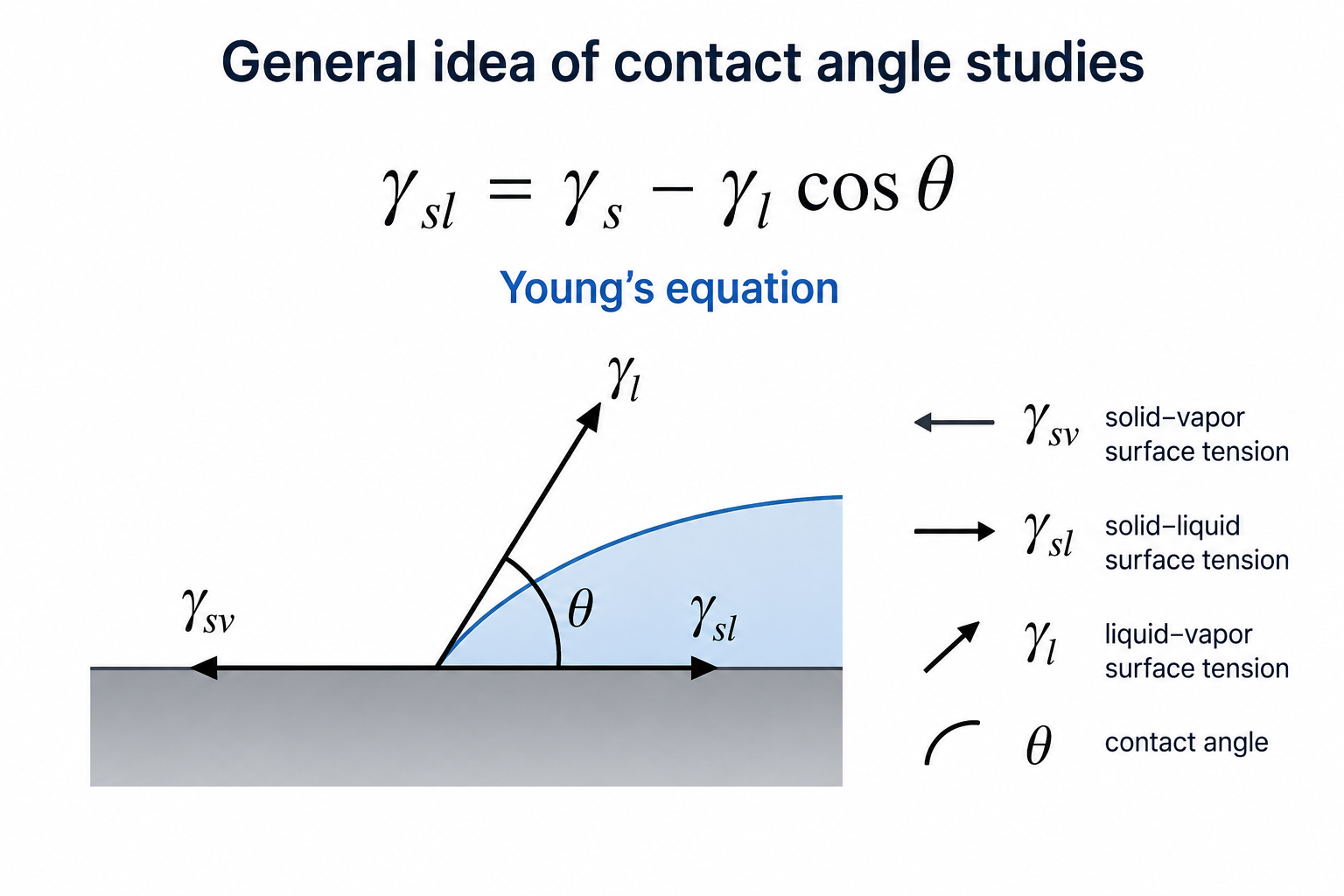
The contact angle is geometric, but its origin is thermodynamic. A droplet shape is determined by the balance of interfacial free energies together with gravity and, on small length scales, capillary pressure. At the three-phase contact line the relevant interfacial quantities are the solid-vapor tension γ_SV, solid-liquid tension γ_SL and liquid-vapor tension γ_LV. For an ideal equilibrium contact line on a smooth homogeneous solid, these quantities satisfy Young's equation. [P1, 1, 4, 6]
Miller lecture presents the subject in a deliberately experimental sequence: general concept, sessile-drop technique, plate-immersion technique, Washburn technique for powders, and finally wetting by surfactant solutions. This sequence is scientifically useful because it moves from the ideal thermodynamic definition toward progressively more realistic systems in which geometry, roughness and time dependence become important. [P1, 5, 15, 13]
The most important caution is that a measured contact angle is not automatically the Young equilibrium angle. Real solids have chemical heterogeneity, topography, adsorbed contaminants and finite stiffness. The three-phase contact line can pin on defects. A droplet can therefore remain mechanically stable over a range of angles without moving. The experimentally accessible advancing and receding angles define this metastable range. [P1, 1, 4, 6]
02 · Scientific Review
Thermodynamic basis of contact angle
2.1 Interfacial free energies at three-phase contact
Consider a liquid droplet resting on a rigid solid in a vapor. Displacing the three-phase contact line by an infinitesimal distance changes the areas of the solid-vapor and solid-liquid interfaces while the liquid-vapor interface changes according to droplet geometry. At equilibrium, the first variation of total interfacial free energy with respect to the contact-line displacement must vanish. [P1, 1, 4]
Young equation
Equivalently, cos θ_Y = (γ_SV - γ_SL)/γ_LV. The angle θ_Y is measured through the liquid. This relation is a force-balance representation of an equilibrium free-energy condition, not a constitutive equation for the solid surface energy by itself. [P1, 5, 6]
2.2 Interpretation of the Young angle
When γ_SV - γ_SL is positive and large relative to γ_LV, cos θ is large and the liquid wets strongly. When the difference is smaller, the angle increases. A contact angle below 90 degrees is conventionally as partial wetting with relatively favorable liquid-solid contact; an angle above 90 degrees is as poor wetting or non-wetting. Miller lecture explicitly classifies contact angles above 90 degrees as non-wetting and angles between 0 and 90 degrees as partial wetting. [P1, 4, 6, 13]
Complete wetting is qualitatively different. The equilibrium contact angle tends toward zero and an isolated equilibrium sessile droplet is no longer the appropriate state. Instead, the liquid spreads into a film. The lecture notes that in this regime only dynamic contact angles can be observed as the droplet spreads and the angle decreases toward zero. [P1, 5, 15, 4]
2.3 Spreading coefficient
The spreading coefficient provides a complementary thermodynamic criterion. For a liquid on a solid in vapor, the coefficient S compares the free energy of the dry solid with that of a solid covered by a macroscopic liquid film. [P1]
Spreading coefficient
For S greater than or equal to zero, complete wetting is thermodynamically favored in the idealized macroscopic description. For S less than zero, a finite equilibrium contact angle is possible. Combining Young's equation with the definition of S gives S = γ_LV(cos θ_Y - 1), which is non-positive for any finite Young angle. [P1, 1, 4, 6]
2.4 Contact angle is a system property
The Young equation makes clear that θ does not belong to the solid alone. Changing the probe liquid changes γ_LV and γ_SL and therefore changes the angle. Likewise, changing the surrounding phase from air to oil changes the relevant interfacial tensions. A surface described as 'hydrophobic' by water contact angle can display very different behavior toward oils or low-surface-tension solvents. [P1, 1, 4, 6]
03 · Scientific Review
Sessile-drop technique
3.1 Basic geometry
The sessile-drop method is the most common optical technique for contact-angle measurement. A droplet of known liquid is placed on a horizontal solid substrate and imaged from the side. The contact angle is obtained from the tangent to the liquid-vapor interface at the three-phase contact line or from a full drop-shape fit. [P1, 1, 4, 5]
For sufficiently small drops, gravity is weak relative to surface tension and the droplet approaches a spherical cap. Larger drops are flattened by gravity. Accurate analysis therefore requires a geometric model appropriate to the droplet size and Bond number. [P1]
3.2 Young-Laplace shape analysis
The liquid-vapor interface obeys the Young-Laplace equation. Axisymmetric drop-shape analysis can fit the complete sessile-drop contour rather than relying solely on a local tangent. Miller lecture cites ADSA-CD and ADSA-MD approaches associated with Neumann and co-workers, illustrating the historical development of quantitative sessile-drop analysis. [P1, 5, 15]
Young-Laplace equation
The advantage of whole-profile fitting is that the curvature field, liquid surface tension and gravitational deformation are treated consistently. The contact angle then follows from the fitted intersection of the theoretical profile with the solid baseline. The accuracy depends critically on edge detection, baseline determination and optical calibration. [P1, 4, 6, 13]
3.3 Baseline selection
Baseline error is one of the most common sources of systematic contact-angle error. A shift of only a few image pixels in the assumed solid-liquid plane can alter the fitted tangent substantially, especially for small droplets. Rough or translucent surfaces make the baseline more difficult to identify. Optical magnification and camera alignment therefore directly influence accuracy. [P1]
3.4 Left and right contact angles
A nominally symmetric droplet can display different left and right contact angles because of local heterogeneity, substrate tilt or nonuniform deposition. Reporting both sides provides more information than reporting a single averaged value. Large asymmetry is often a warning that the droplet is not in a reproducible equilibrium state. [P1, 6, 11, 13]
3.5 Liquid-liquid-solid systems
Sessile-drop contact-angle measurements can also be performed with one liquid immersed in another. The relevant surface is then a liquid-liquid interface, and the surrounding phase is no longer a passive gas. Miller lecture explicitly includes the sessile-drop technique in liquid-liquid-solid systems. Such measurements are important for oil displacement, detergency, flotation and emulsion-related solid wetting. [P1, 5, 15, 4]
The interpretation uses the same three-phase thermodynamic principle but with the liquid-liquid interfacial tension in place of γ_LV. Density difference, phase purity and mutual solubility become important experimental parameters. [P1, 1, 4]
04 · Scientific Review
Advancing and receding contact angles
4.1 Why a single static angle is insufficient
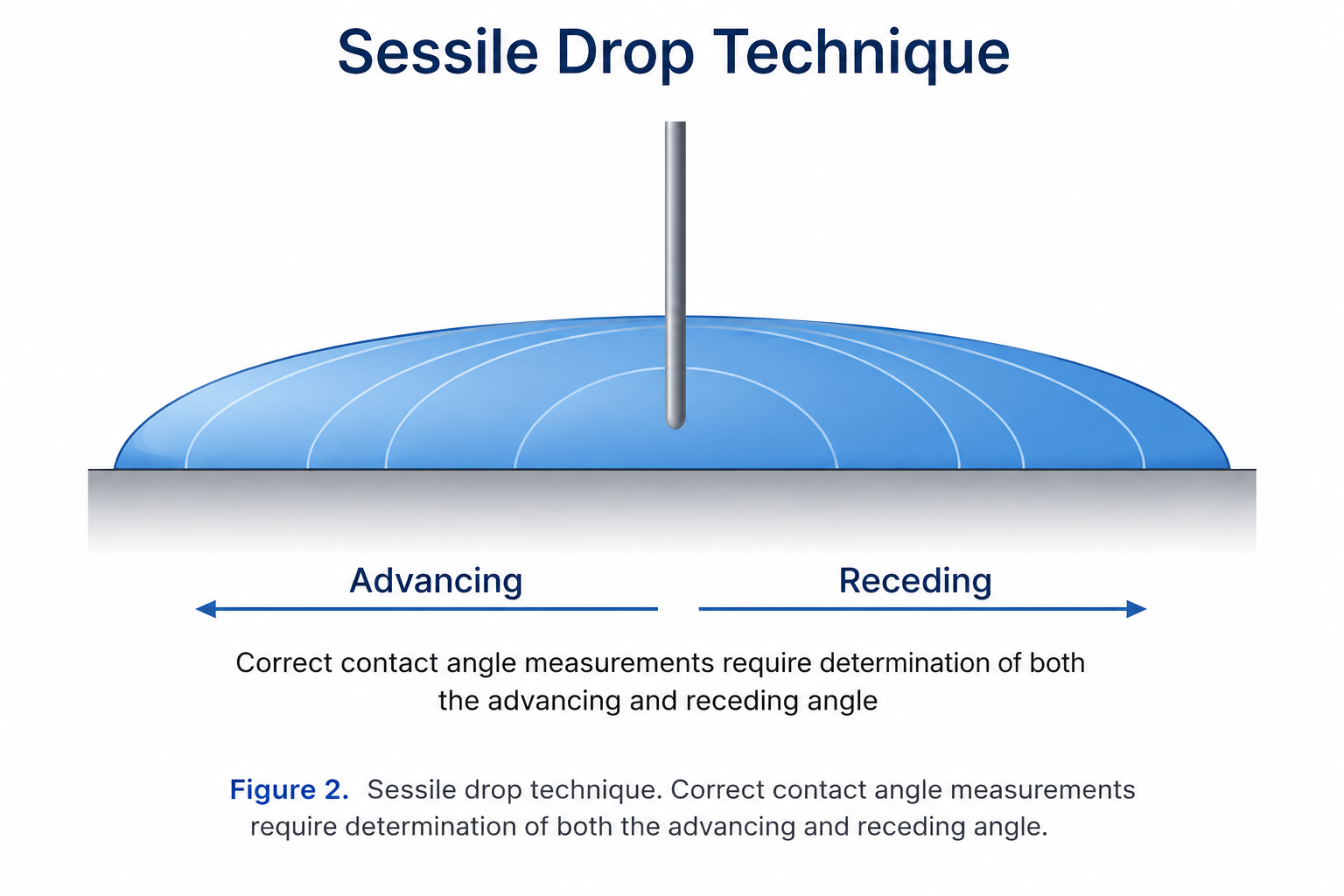
The source lecture is unequivocal that correct contact-angle measurements require determination of both advancing and receding angles. A contact line on a real surface can remain pinned while droplet volume changes. The contact angle then changes without movement of the contact line. Only when a limiting angle is reached does the line advance or recede. [P1, 6, 11, 13]
4.2 Advancing angle
The advancing angle θ_A is measured while liquid volume is increased slowly. Initially the footprint may remain fixed while the droplet grows and the angle rises. Once the contact line depins, the footprint expands. The angle maintained during quasisteady outward motion is identified as the advancing contact angle under the specific protocol. [P1, 6, 11, 13]
4.3 Receding angle
The receding angle θ_R is measured while liquid is withdrawn. The footprint can remain pinned as volume decreases and the angle falls. When the contact line begins to retreat, the limiting angle defines the receding angle. [P1, 6, 11, 13]
Contact-angle hysteresis
4.4 Physical origin of hysteresis
Hysteresis is caused by metastability of the contact line. Chemical patches, roughness features, scratches, pores, contamination and microscopic changes in surface chemistry create local energy barriers. The contact line can therefore occupy multiple mechanically stable configurations within an interval of contact angles. [P1, 6, 11, 13]
The hysteresis range contains information that the static angle does not. A surface can have a high apparent water angle but also a very large hysteresis, causing droplets to stick strongly. Conversely, a surface with a similar static angle and low hysteresis can permit easy droplet roll-off. [P1, 6, 11, 13]
4.5 Dynamic contact angle versus advancing/receding limits
Advancing and receding angles are often measured at very low contact-line velocity and treated as quasistatic limits. At finite velocity, the observed dynamic angle can depend on speed through viscous dissipation, microscopic slip and molecular kinetics at the moving contact line. Therefore, measurement rate should be reported rather than assumed irrelevant. [P1, 6, 11, 13]
05 · Scientific Review
Contact-line pinning and wetting kinetics
The motion of the three-phase contact line is central to practical wetting. When a droplet volume increases on a pinned footprint, its radius, height and contact angle do not change linearly with volume. Miller lecture explicitly illustrate a linear increase in drop volume accompanied by nonlinear evolution of drop radius and contact angle before the line begins to move. [P1, 1, 4, 6]
Pinning converts the equilibrium Young condition into a metastable inequality. Within the hysteresis interval, an imbalance of interfacial forces exists but is insufficient to overcome defect-induced barriers. The contact line moves only when the driving force exceeds the local pinning threshold. [P1, 6, 11, 13]
This picture explains why surface preparation matters so strongly. Polishing, plasma treatment, oxidation, coating, contamination and aging can all modify the density and strength of pinning sites. A contact-angle value without a documented surface-preparation protocol is therefore difficult to compare across laboratories. [P1, 6, 11, 13]
06 · Scientific Review
Surface free energy from contact-angle measurements
6.1 The inverse problem
Young's equation contains two solid-related unknowns, γ_SV and γ_SL. A single contact-angle measurement with one liquid therefore cannot determine the solid surface free energy . Additional assumptions or an additional constitutive equation are required. [P1, 4, 8, 9]
The Miller lecture explicitly presents this as an inverse problem and reviews empirical or semi-empirical approaches for estimating solid surface energy, including Fowkes-type treatments and the Neumann equation-of-state approach. These methods differ in how they relate the solid-liquid interfacial energy to properties of the separate phases. [P1, 4, 8, 9]
6.2 Fowkes-type component approaches
Fowkes introduced the idea that surface free energy can be decomposed into contributions associated with different intermolecular interactions, beginning with dispersive forces. Later approaches extended the decomposition to polar or acid-base components. Contact angles measured with several probe liquids are then used to solve for the unknown solid components. [P1, 4, 8, 9]
The usefulness of these methods depends on the validity of the chosen combining rule and the availability of reliable liquid parameters. Results from different models are not automatically interchangeable, and a quoted 'surface energy of the solid' should always identify the model used. [P1]
6.3 Neumann equation of state
Neumann and co-workers proposed an equation-of-state approach in which the solid-liquid interfacial tension is related empirically to the surface tensions of the pure solid and liquid phases. The Miller lecture the Neumann equation of state and shows calculated contact-angle dependence on solid surface tension for liquids with different γ_LV. [P1, 4, 8, 9]
The attraction of the equation-of-state method is that a single carefully measured contact angle can, in principle, be used to estimate a solid surface-energy parameter. The limitation is that the result inherits the empirical assumptions of the equation. It should therefore be regarded as model-based rather than as a direct measurement. [P1, 4, 6, 13]
6.4 Why surface-energy values can disagree
Different probe liquids, fitting methods and surface-energy models can yield different numerical values for the same substrate. This does not necessarily indicate experimental incompetence; it reflects the fact that solid surface energy is inferred indirectly. Chemical heterogeneity and roughness can further violate the assumptions of smooth homogeneous equilibrium thermodynamics. [P1, 6, 11, 13]
07 · Scientific Review
Wetting on rough surfaces
7.1 Roughness changes apparent wetting
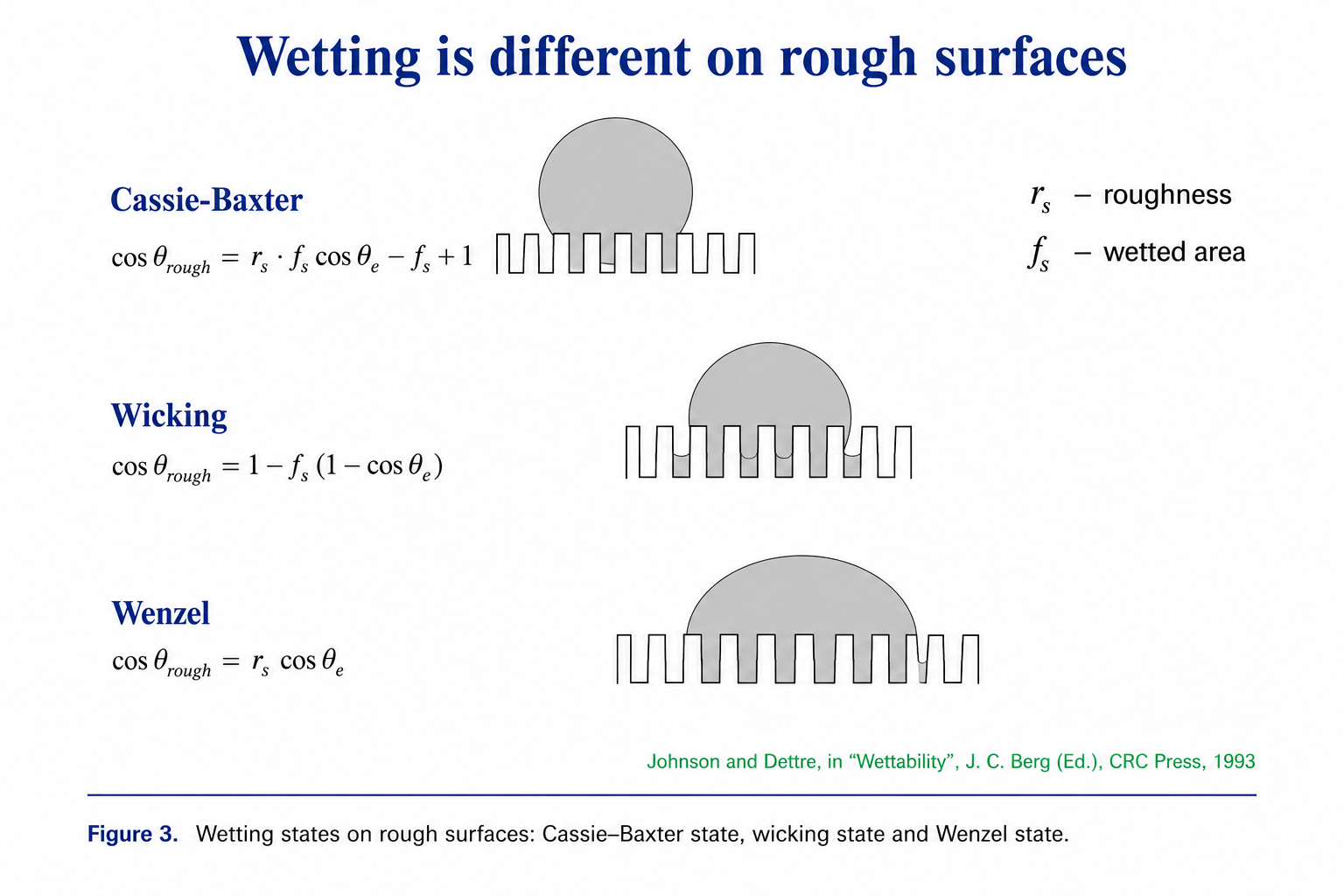
The Miller lecture emphasizes that wetting is different on rough surfaces and presents Wenzel, Cassie-Baxter and wicking as distinct scenarios. Roughness modifies both the true solid-liquid contact area and the configuration of the liquid beneath the apparent contact plane. [P1, 2, 3, 4]
7.2 Wenzel state
In the Wenzel state, the liquid follows the surface topography so that the entire roughness is wetted. Wenzel's classical relation connects the apparent contact angle θ_W to the Young angle θ_Y through the roughness ratio r, defined as the true wetted area divided by the projected area. [P1, 1, 4, 2]
Wenzel relation
r ≥ 1 for a rough surface.
The equation predicts that roughness amplifies the intrinsic tendency of the surface: a hydrophilic Young surface becomes more hydrophilic and a hydrophobic Young surface becomes more hydrophobic. The model assumes complete liquid penetration into the roughness and a geometrically meaningful roughness ratio. [P1, 2]
7.3 Cassie-Baxter state
In a Cassie-Baxter state, the droplet rests on a composite interface. For a textured hydrophobic surface, part of the apparent contact area is solid while another fraction may be trapped air. The effective apparent angle is determined by the area fractions and the contact angles associated with the individual components. [P1, 3, 4, 6]
Cassie-Baxter relation
For a solid-air composite beneath a water droplet, one component is effectively the liquid-air contact with cos 180° = -1. [P1]
A common special form for a solid fraction f_s and trapped air is cos θ_CB = f_s(cos θ_Y + 1) - 1. Low solid fraction can therefore produce very high apparent contact angles. [P1, 4, 6, 13]
7.4 Metastability and transitions
Wenzel and Cassie-Baxter should be regarded as limiting states, not a complete classification of every rough surface. Real droplets can partially infiltrate texture, become pinned at intermediate states, or transition from Cassie-like to Wenzel-like wetting under pressure, vibration or evaporation. [P1, 2, 3, 4]
This is one reason why high contact angle alone does not define a robust superhydrophobic surface. A metastable Cassie state may collapse under small perturbations, producing large hysteresis and irreversible wetting of the texture. [P1, 3, 6, 11]
7.5 Wicking
Highly wettable rough or porous structures can draw liquid into grooves and pores by capillary action. In this wicking regime, a macroscopic sessile-drop angle may no longer capture the relevant wetting process. The dynamics are governed by capillary pressure, viscous resistance and pore geometry. [P1, 5, 15, 13]
08 · Scientific Review
Plate immersion and Wilhelmy-type contact-angle measurements
8.1 Principle
A plate-immersion technique determines wetting from the vertical force acting on a solid as it crosses a liquid interface. The capillary force depends on the liquid surface tension, the wetted perimeter and the cosine of the contact angle. Buoyancy contributes an additional force once the plate is immersed. [P1, 5, 6, 4]
Wilhelmy capillary force
If γ_LV and the wetted perimeter P are known, the contact angle can be inferred from the measured force after buoyancy and instrument zero are accounted for. The method is especially useful for dynamic advancing and receding measurements because immersion and withdrawal provide controlled contact-line motion. [P1, 6, 11, 13]
8.2 Advancing and receding by immersion
During immersion, the liquid advances over previously dry solid and an advancing angle is measured. During withdrawal, the liquid recedes and a receding angle is obtained. This geometry can be more reproducible than dosing and withdrawing a sessile droplet when the sample is plate-like and chemically uniform. [P1, 6, 11, 13]
8.3 Limitations
The method requires well-defined plate geometry, accurate force calibration and a sufficiently uniform surface around the perimeter. Swelling, dissolution, contamination or a changing contact perimeter complicate interpretation. Rough surfaces can generate strong force fluctuations as the contact line pins and depins. [P1, 5, 6]
09 · Scientific Review
Washburn method for powders and porous solids
9.1 Why powders require a different approach
A sessile droplet cannot provide a representative contact angle for an unconsolidated powder bed because there is no unique planar surface. The Washburn approach infers an effective wetting angle from capillary penetration of liquid into the porous network. [P1, 5, 15, 13]
Miller lecture describes the experimental sequence: a tube filled with powder is brought into contact with the liquid; liquid begins to rise by capillary forces; the uptake progresses through an intermediate regime; and a final equilibrium weight is approached. [P1, 13, 5, 6]
9.2 Washburn relation
For a capillary bundle or equivalent porous medium, the penetration rate results from a balance between capillary pressure and viscous resistance. In practical powder tensiometry the increase in mass or weight is recorded as a function of time. The simplified relation contains the liquid density, viscosity, surface tension, a geometric coefficient of the powder and cos θ. [P1, 13]
Washburn-type uptake relation
The geometric coefficient K depends on the pore structure and packing and is not known a priori. It is commonly calibrated using a completely wetting reference liquid for which cos θ is approximated as unity. The unknown liquid can then be measured using the same packed-bed preparation. [P1, 4, 6, 13]
9.3 Effective contact angle
The Washburn angle is an effective parameter of the powder bed rather than the Young angle of a single ideal particle surface. Packing density, pore-size distribution, particle shape and swelling can influence the uptake. Reproducible sample preparation is therefore essential. [P1, 1, 4, 13]
9.4 Applications
The method is widely relevant to pharmaceutical powders, pigments, battery materials, minerals, food powders and porous coatings. It provides a practical measure of liquid affinity where conventional sessile-drop geometry is unavailable. [P1, 5, 15, 13]
10 · Scientific Review
Dynamic wetting by surfactant solutions
10.1 Why all interfacial quantities become time dependent
Miller lecture a particularly important practical statement: for spreading of surfactant solutions, all relevant quantities are dynamic. The liquid-vapor tension changes as surfactant adsorbs to the newly created surface. The solid-liquid interfacial free energy changes as surfactant adsorbs or reorganizes at the solid-liquid interface. The solid-vapor surface may also carry pre-adsorbed material or exchange with the environment. [P1, 7, 12]
Young's equation therefore remains a thermodynamic reference relation, but its interfacial tensions cannot be assumed to have reached equilibrium simultaneously during spreading. The observed contact angle becomes a kinetic observable. [P1, 4, 6, 13]
10.2 Dynamic surface tension and spreading
A freshly formed surfactant-solution surface can initially possess a tension much closer to that of pure solvent than to the equilibrium tension of the formulation. As adsorption proceeds, γ_LV decreases. If the droplet spreads on a comparable timescale, the capillary driving force changes continuously during the wetting process. [P1, 5, 6, 7]
Miller, Dutschk and Fainerman analyzed the influence of molecular processes at liquid interfaces on dynamic surface tensions and wetting kinetics. Their central physical message is that wetting kinetics cannot be predicted from equilibrium surface tension alone when adsorption and contact-line motion occur on similar timescales. [P1, 7, 12, 4]
10.3 Adsorption at the solid-liquid interface
Surfactants can also adsorb on the solid, changing γ_SL. The direction and magnitude depend on surface chemistry and surfactant structure. Adsorption can make a hydrophobic surface more hydrophilic or, in other cases, reverse surface charge and modify wetting in non-monotonic ways. [P1, 7, 12, 4]
10.4 Concentration dependence
Increasing surfactant concentration usually accelerates adsorption and reduces equilibrium liquid-vapor tension, but the resulting contact angle not change monotonically. The solid-liquid adsorption isotherm, micellization and competitive adsorption can all modify the wetting response. [P1, 7, 12, 4]
Practical rule. For surfactant formulations, report the contact-angle measurement time or contact-line velocity together with concentration. A single static angle measured after an arbitrary waiting period is rarely sufficient to describe process wetting. [P1, 7, 12, 4]
11 · Scientific Review
Dynamic contact-line physics
11.1 Viscous dissipation
A moving contact line generates flow in the liquid wedge near the substrate. Classical hydrodynamics predicts a stress singularity if no-slip is imposed all the way to the contact line, indicating the need for microscopic regularization through slip, precursor films or molecular kinetic processes. At finite speed, viscous dissipation causes the dynamic contact angle to deviate from its quasistatic value. [P1, 4, 6, 13]
11.2 Molecular kinetic contribution
From a molecular perspective, contact-line motion requires local attachment and detachment of liquid molecules from the solid surface. Surface heterogeneity changes the activation barriers for these elementary steps. This provides another route by which surface chemistry influences dynamic wetting beyond the equilibrium Young angle. [P1, 1, 4, 6]
11.3 Capillary number
The ratio of viscous to capillary forces is represented by the capillary number Ca = ηU/γ, where U is a characteristic contact-line speed. Dynamic-angle effects generally increase as Ca increases. [P1, 5, 6]
Capillary number
Measurements intended to approximate advancing and receding equilibrium limits should therefore use sufficiently low and reproducible contact-line velocities. High-speed coating and printing require the opposite approach: the dynamic angle at process-relevant Ca is the quantity of interest. [P1, 6, 11, 13]
12 · Scientific Review
Surface preparation and contamination
12.1 Cleaning
Contact angles are extremely sensitive to molecular contamination. Organic residues on glass, oxide or metal surfaces can increase water contact angle substantially. A cleaning protocol should therefore be defined and validated rather than described simply as 'clean'. [P1, 4, 6, 13]
12.2 Aging after surface treatment
Plasma- or UV-ozone-treated surfaces can undergo hydrophobic recovery as airborne organics adsorb or polymer chains reorient. Contact angle can therefore change with time after treatment. The delay between preparation and measurement should be standardized. [P1, 4, 6, 13]
12.3 Roughness and morphology
A chemically identical treatment can produce different apparent contact angles if the morphology differs. Surface roughness should be measured independently when Wenzel or Cassie-type interpretation is attempted. Contact angle alone cannot distinguish chemistry from topography. [P1, 2, 3, 4]
12.4 Absorption, swelling and dissolution
Polymers, porous coatings and biological materials can absorb the probe liquid or swell during the measurement. The baseline and droplet volume then change with time. Such systems require time-resolved analysis and often cannot be represented by a single equilibrium Young angle. [P1, 1, 4, 13]
13 · Scientific Review
Measurement uncertainty and best practice
13.1 Droplet volume
Droplet volume influences gravitational deformation, evaporation rate and the number of surface defects sampled by the contact line. A standardized volume improves comparability. Very small droplets probe more local heterogeneity, while large droplets average over a wider area but are more gravity-deformed. [P1, 6, 11, 13]
13.2 Dosing history
The needle can remain inside the droplet for dynamic volume measurements, but it can perturb the shape if positioned improperly. For static measurements, removal of the needle can introduce vibration or volume loss. The exact dosing protocol should be reproducible. [P1]
13.3 Evaporation
Evaporation changes droplet volume and can drive the contact line from an advancing-like state toward a receding state. It also changes concentration in nonvolatile solute solutions. Humidity control or rapid measurement is therefore important for volatile liquids. [P1, 6, 11, 13]
13.4 Temperature
Liquid surface tension, viscosity, adsorption and solid surface chemistry can all depend on temperature. Contact-angle measurements intended for quantitative surface-energy analysis should be performed at controlled temperature. [P1, 7, 12]
13.5 Replication across positions
Because real surfaces are heterogeneous, replicate droplets should be placed at multiple positions rather than repeatedly measuring the same location. Reporting the distribution of values often conveys more information than a single mean. [P1, 6, 11, 13]
13.6 Advancing and receding as primary data
For rigorous wettability characterization, advancing and receding values should be treated as primary observables. A single static contact angle lies somewhere within the hysteresis range and is strongly dependent on how the droplet was deposited. [P1, 6, 11, 13]
14 · Scientific Review
Interpreting hydrophilicity, hydrophobicity and superhydrophobicity
The terms hydrophilic and hydrophobic are useful shorthand but should not replace quantitative reporting. A water angle below 90 degrees is commonly called hydrophilic and above 90 degrees hydrophobic. This classification says little about hysteresis, roll-off, roughness state or wetting by other liquids. [P1, 6, 11, 13]
Superhydrophobic surfaces are commonly associated with very high apparent water angles and low contact-angle hysteresis. The low hysteresis requirement is physically important because it distinguishes a mobile Cassie-like droplet from one strongly pinned on a rough surface. [P1, 3, 6, 11]
Similarly, superhydrophilic behavior often involves rapid spreading and apparent angles approaching zero. In this regime, dynamic spreading rate may be more informative than a nominal contact angle. [P1, 4, 6, 13]
15 · Scientific Review
Applications
15.1 Coatings and adhesion
A liquid coating must wet the substrate sufficiently to form a continuous film. Contact angle provides a first measure of wetting tendency, while advancing dynamics reveal whether the liquid can spread at the coating speed. Surface-energy analysis is widely used to assess pretreatment, corona discharge, plasma cleaning and primer performance. [P1, 6, 11, 13]
15.2 Printing and inks
Ink deposition involves a rapidly moving contact line. Both liquid surface tension and substrate surface energy affect spreading, dot gain and edge definition. Surfactant adsorption can continue during the millisecond-to-second period after impact, making dynamic wetting particularly relevant. [P1, 7, 12, 4]
15.5 Pharmaceuticals and powders
Powder wettability affects granulation, dissolution, suspension preparation and coating. Because conventional contact-angle geometry is often unavailable, capillary uptake methods are particularly relevant. Surface modification by binders or surfactants can be evaluated through changes in effective wetting behavior. [P1, 13, 7, 12]
15.6 Detergency
Cleaning requires wetting of both the substrate and the soil phase. Surfactants alter liquid-vapor tension and adsorb at solid-liquid and oil-water interfaces. Equilibrium contact angle alone therefore provides an incomplete description of detergent action; dynamic spreading and interfacial adsorption must be considered together. [P1, 7, 12, 4]
15.7 Flotation and particle interfaces
Particle attachment to bubbles depends strongly on particle wettability. The separate lecture on particles at interfaces notes that surface energy controls particle self-assembly at liquid interfaces and that surfactants can modify particle hydrophobicity. Contact angle is therefore a central parameter in flotation and Pickering stabilization, although measuring the angle of a single micron-scale particle is experimentally challenging. [P1, 7, 12, 4]
16 · Scientific Review
Choosing the appropriate experimental method
For flat, optically accessible surfaces, sessile-drop analysis is the default method. It provides direct geometry and allows dynamic advancing and receding measurements through controlled volume change. For plate-like solids and force-based dynamic measurements, immersion methods offer a robust alternative. For powders and porous beds, Washburn analysis provides an effective capillary wetting parameter. [P1, 6, 11, 13]
The measurement principle should follow the material geometry rather than forcing every sample into a sessile-drop experiment. A rough porous powder compact can yield a visually precise but physically misleading apparent angle if infiltration occurs beneath the droplet. [P1, 5, 15, 13]
For surfactant solutions, the method must also resolve time. Automated video acquisition and controlled dosing are preferable because both the liquid surface tension and the contact angle can evolve during the experiment. [P1, 7, 12, 4]
17 · Scientific Review
Recommended reporting standard
A scientifically complete contact-angle report should identify the solid material, surface treatment, cleaning procedure, roughness or morphology where relevant, storage history and time between treatment and measurement. The probe liquid should be specified by composition, purity and temperature. [P1]
The droplet volume, image-analysis method, baseline procedure, camera magnification and fitting approach should be stated. For dynamic measurements, the dosing or withdrawal rate and contact-line velocity should be included. Advancing and receding angles should be reported separately together with the number and spatial distribution of replicates. [P1, 6, 11, 13]
If a solid surface-energy value is inferred, the exact model and probe-liquid parameters must be given. If Wenzel or Cassie-Baxter analysis is used, the independently measured roughness ratio or area fraction should be reported rather than treated as an unconstrained fitting parameter. [P1, 2, 3]
For powders, packing procedure, sample mass, tube geometry, calibration liquid, liquid viscosity, density and surface tension are required for reproducible Washburn analysis. [P1, 13]
18 · Scientific Review
Conclusions
Contact angle is the macroscopic geometric expression of a three-phase interfacial free-energy balance. Young's equation provides the thermodynamic reference for a smooth, homogeneous, rigid surface at equilibrium. It establishes that the angle depends on γ_SV, γ_SL and γ_LV and is therefore a property of the complete solid-liquid-surrounding-phase system. [P1, 1, 4, 6]
Real contact-angle measurements are dominated by metastability. Chemical heterogeneity and roughness pin the contact line, producing distinct advancing and receding angles. The hysteresis between these limits is not merely experimental scatter; it is an intrinsic signature of the energy barriers encountered by the moving contact line. Reporting only a single static angle discards this information. [P1, 6, 11, 13]
Rough surfaces introduce alternative wetting states. Wenzel wetting corresponds to complete liquid penetration into topography, whereas Cassie-Baxter wetting corresponds to a composite interface. These models are useful limiting descriptions but should not be applied mechanically to arbitrary surfaces without independent morphological evidence. [P1, 2, 3, 4]
Surface free energy cannot be determined directly from one contact angle without an additional model. Fowkes-type component approaches and the Neumann equation of state provide model-dependent routes to infer solid surface-energy parameters. Results should therefore always be reported together with the chosen framework. [P1, 4, 8, 9]
Experimental method selection depends on sample geometry. Sessile-drop analysis is best suited to planar surfaces; immersion techniques provide dynamic force-based contact angles; Washburn analysis extends wetting characterization to powders and porous solids. In all cases, cleanliness, temperature, evaporation, roughness and preparation history are central sources of uncertainty. [P1, 5, 15, 13]
The most important extension beyond classical equilibrium wetting is the behavior of surfactant solutions. Here the liquid-vapor, solid-liquid and potentially solid-vapor interfacial states evolve with concentration and time. Wetting kinetics and dynamic surface tension become coupled. For practical formulations, contact angle must therefore be treated as a dynamic interfacial observable rather than as a timeless material constant. [P1, 7, 12, 4]
19 · Scientific Review
Common interpretation errors and a practical decision framework
19.1 Treating the static angle as an equilibrium constant
A deposited sessile droplet can stop at any angle within the pinning interval between the advancing and receding limits. The resulting static angle depends on deposition volume, needle withdrawal, vibration and local surface defects. It should therefore not be identified automatically with the Young equilibrium angle. When the scientific question concerns intrinsic wettability, advancing and receding measurements provide the more defensible experimental description. [P1, 6, 11, 13]
19.2 Inferring cleanliness from one water angle
Water contact angle is highly sensitive to organic contamination and is therefore useful for cleanliness control, but one number cannot identify the chemical origin of a change. A larger angle may result from hydrocarbon contamination, surface reconstruction, loss of hydroxyl groups or altered roughness. Contact angle is best regarded as a sensitive comparative indicator and, where chemical identification is required, should be combined with spectroscopy or other surface-analysis methods. [P1, 4, 6, 13]
19.3 Using Wenzel or Cassie-Baxter as unconstrained fitting equations
The Wenzel roughness ratio and Cassie-Baxter area fraction have geometric meaning. If they are allowed to vary freely merely to reproduce an observed angle, an excellent numerical fit can be obtained without demonstrating the proposed wetting state. Morphological measurements, imaging, roll-off behavior or independent evidence of trapped air should therefore accompany model assignment. The apparent angle alone does not distinguish a Wenzel state from a Cassie-like state uniquely. [P1, 2, 3, 4]
19.4 Comparing surface-energy values from different models
Surface-energy values derived by Fowkes-type, Owens-Wendt-type, acid-base or Neumann equation-of-state procedures can differ because they solve different inverse problems with different assumptions. A value such as '42 mJ/m²' is incomplete unless the model, probe liquids and contact-angle protocol are specified. For process control, consistency of one validated method is often more valuable than attempting to identify a supposedly model-independent absolute surface energy. [P1, 4, 8, 9]
19.5 Selecting the quantity that matches the application
The most useful wetting observable depends on the application. For coating initiation, the advancing dynamic angle is often more relevant than a long-time static value. For droplet retention and roll-off, hysteresis and the receding angle are critical. For porous-media infiltration, capillary uptake and an effective Washburn angle may be more representative than a sessile droplet. For surfactant formulations, contact angle should be evaluated together with dynamic surface tension because the liquid-vapor interface itself is evolving during spreading. [P1, 6, 11, 13]
This decision-based interpretation is consistent with the central message of Miller lecture: contact-angle measurement looks simple but is not. The angle is meaningful only when the deformation and contact-line history, surface state and relevant interfacial timescale are defined. Rather than searching for one universal wettability number, rigorous characterization identifies the observable that corresponds to the physical process being investigated. [P1, 4, 6, 13]
Source basis
Source basis
Primary sources
P1. Liquid Solid Interactions: Contact Angles & Wettability, by SINTERFACE Technologies.
P2. Simple Experimental Methods, by SINTERFACE Technologies.
P3. Particles at Liquid Interfaces, by SINTERFACE Technologies.
References
References
1. T. Young, An Essay on the Cohesion of Fluids, Philosophical Transactions of the Royal Society of London 95 (1805) 65-87.
2. R. N. Wenzel, Resistance of Solid Surfaces to Wetting by Water, Industrial & Engineering Chemistry 28 (1936) 988-994. DOI: 10.1021/ie50320a024.
3. A. B. D. Cassie and S. Baxter, Wettability of Porous Surfaces, Transactions of the Faraday Society 40 (1944) 546-551. DOI: 10.1039/TF9444000546.
4. A. W. Neumann and J. K. Spelt (Eds.), Applied Surface Thermodynamics, Surfactant Science Series, Vol. 63, Marcel Dekker, 1996.
5. D. Möbius and R. Miller (Eds.), Drops and Bubbles in Interfacial Research, Studies in Interface Science, Vol. 6, Elsevier, Amsterdam, 1998.
6. M. Ferrari, L. Liggieri and R. Miller (Eds.), Drops and Bubbles in Contact with Solid Surfaces, Progress in Colloid and Interface Science, CRC Press, 2013.
7. S. S. Dukhin, G. Kretzschmar and R. Miller, Dynamics of Adsorption at Liquid Interfaces, Studies in Interface Science, Vol. 1, Elsevier, Amsterdam, 1995.
8. D. Li and A. W. Neumann, Equation of state for interfacial tensions of solid-liquid systems, Advances in Colloid and Interface Science 39 (1992) 299-345.
9. F. M. Fowkes, Attractive forces at interfaces, Industrial & Engineering Chemistry 56 (1964) 40-52.
10. R. J. Good, Surface free energy of solids and liquids: thermodynamic, molecular and experimental aspects, Journal of Colloid and Interface Science 59 (1977) 398.
11. C. Huh and S. G. Mason, effects of surface heterogeneity and contact-line behavior in wetting, Colloid & Polymer Science 253 (1975) 566.
12. R. Miller, V. Dutschk and V. B. Fainerman, Influence of molecular processes at liquid interfaces on dynamic surface tensions and wetting kinetics, Journal of Adhesion 80 (2004) 549-561.
13. J. C. Berg (Ed.), Wettability, Surfactant Science Series, Marcel Dekker, 1993.
14. H. Chen, J. L. Muros-Cobos and A. Amirfazli, Contact angle measurement with a smartphone, Review of Scientific Instruments 89 (2018) 035117.
15. P. Chen and co-workers, contact-angle and axisymmetric drop-shape methods, in: D. Möbius and R. Miller (Eds.), Drops and Bubbles in Interfacial Research, Elsevier, 1998.