Glossary

Dilational rheology

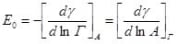
For the dilational rheology the parameter E0 is defined as the dilational elasticity module
Formula

This parameter results directly from the interfacial thermodynamics. Using for example the Langmuir isotherm (see above) we obtain the following relationship

Formula

When harmonic perturbations are imposed to an interfacial layer an oscillation behaviour of the interfacial tension is observed. This behaviour can be described by the complex elasticity E(iω) defined by the following equation

Formula

For a diffusion controlled exchange of matter we obtain
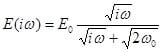
Formula

where the real and imaginary parts are given by
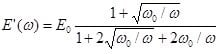
Formula
Experiments are performed to measure the frequency f dependence of E' and E" in order to find the characteristic relaxation frequencies of an interfacial layer. Here,
Formula
and
Formula
is the diffusion relaxation time.

A typical dilational experiment can be carried out with the drop shape tensiometer PAT.

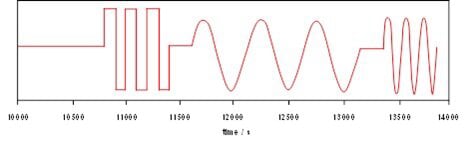
Using the dosing system the drop area can be subjected to transient or harmonic perturbations, such as those shown in the following graph: after 3 h keeping the drop surface area constant (10800 s) first 3 square pulses are performed, and then 3 oscillations each at 2 frequencies.

Scientific Setup

Figure 1: Experimental setup for profile analysis tensiometry.

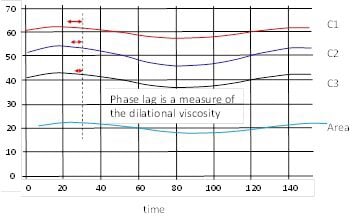
From such experiments we can determine the dilation elasticity and viscosity. The phase lag between g(t) and the area change is a measure of the dilational viscosity.
Scientific Setup

Figure 1: Experimental setup for profile analysis tensiometry.

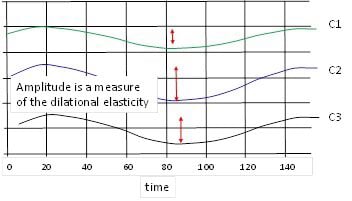
On the other hand, the amplitude of g(t) is a measure of the elasticity at the given frequency.
Scientific Setup

Figure 1: Experimental setup for profile analysis tensiometry.

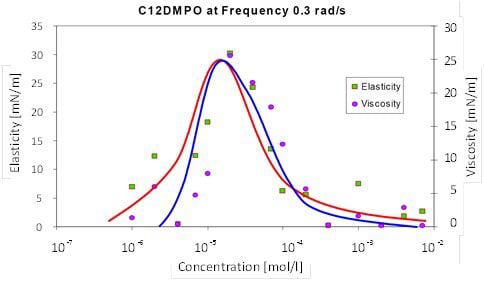
With increasing bulk concentration the elasticity E' increases and passes through a maximum. The same happens with the viscous term E", as one can see in the following graph showing results for a model surfactant (dodecyl dimethyl phosphine oxide) at a frequency of 0.3 rad/s = 0.048 Hz.

Scientific Setup

Figure 1: Experimental setup for profile analysis tensiometry.

The measured dilational rheology is a function of frequency and only at very high oscillation rates a plateau value is reached, which theoretically should coincide with the value of E0 obtained from the adsorption isotherm.
Back to Science Glossary