Glossary

2D Rheology - general idea

When interfacial layers are deformed there are forces acting against this deformation. There are principally two forms of deformation:
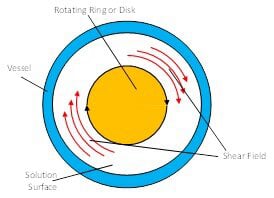
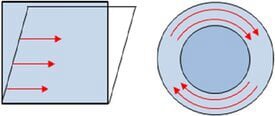
- shear deformation: changing shape of the interface at constant area
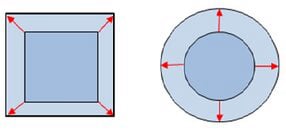
- dilational deformation: constant shape but changing surface area.

The possibility of expansion and compression of an interfacial layer is a peculiarity different to bulk rheology, where in a first approach incompressible liquids are assumed.
Scientific Setup

Figure 1: Expansion or compression deformation.
Scientific Setup

Figure 1: Shear deformation 

Both types of deformation provide one elasticity and one viscosity parameter, each.

A first complete book on interfacial rheology was published recently (R. Miller and L. Liggieri (Eds.), Interfacial Rheology, Vol. 1, Progress in Colloid and Interface Science, Brill Publ., Leiden, 2009, p. 567-613, ISBN 978 90 04 17586 0).
Scientific Setup

Figure 1: Experimental setup for profile analysis tensiometry.
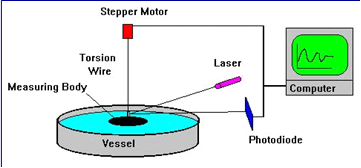
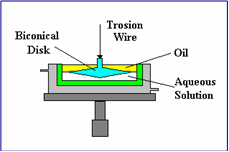
For surface layers the general set-up of the shear rheometer ISR-1 is shown in the schematic below. On the right side a special biconical disk is shown which is used for experiments at liquid-liquid interfaces.
Scientific Setup

Figure 1: Experimental setup for profile analysis tensiometry.
Scientific Setup

Figure 1: Experimental setup for profile analysis tensiometry.
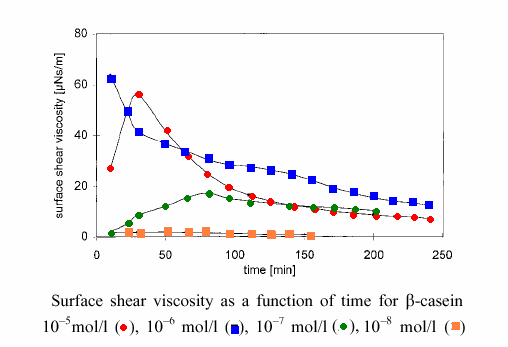
The surface shear viscosity of ß-casein is shown in the following figure. Depending on the bulk concentration, the shear viscosity increases and then drops down again.
Scientific Setup

Figure 1: Experimental setup for profile analysis tensiometry.

This behaviour can be explained by the structure of the interfacial layer formed by the
β-casein molecules, which is more cross-linked at lower surface coverage with more unfolded protein molecules, and less cross-linked at higher surface coverage.  
Back to Science Glossary